
Research Compound Shipping in India | Documentation Questions to Ask
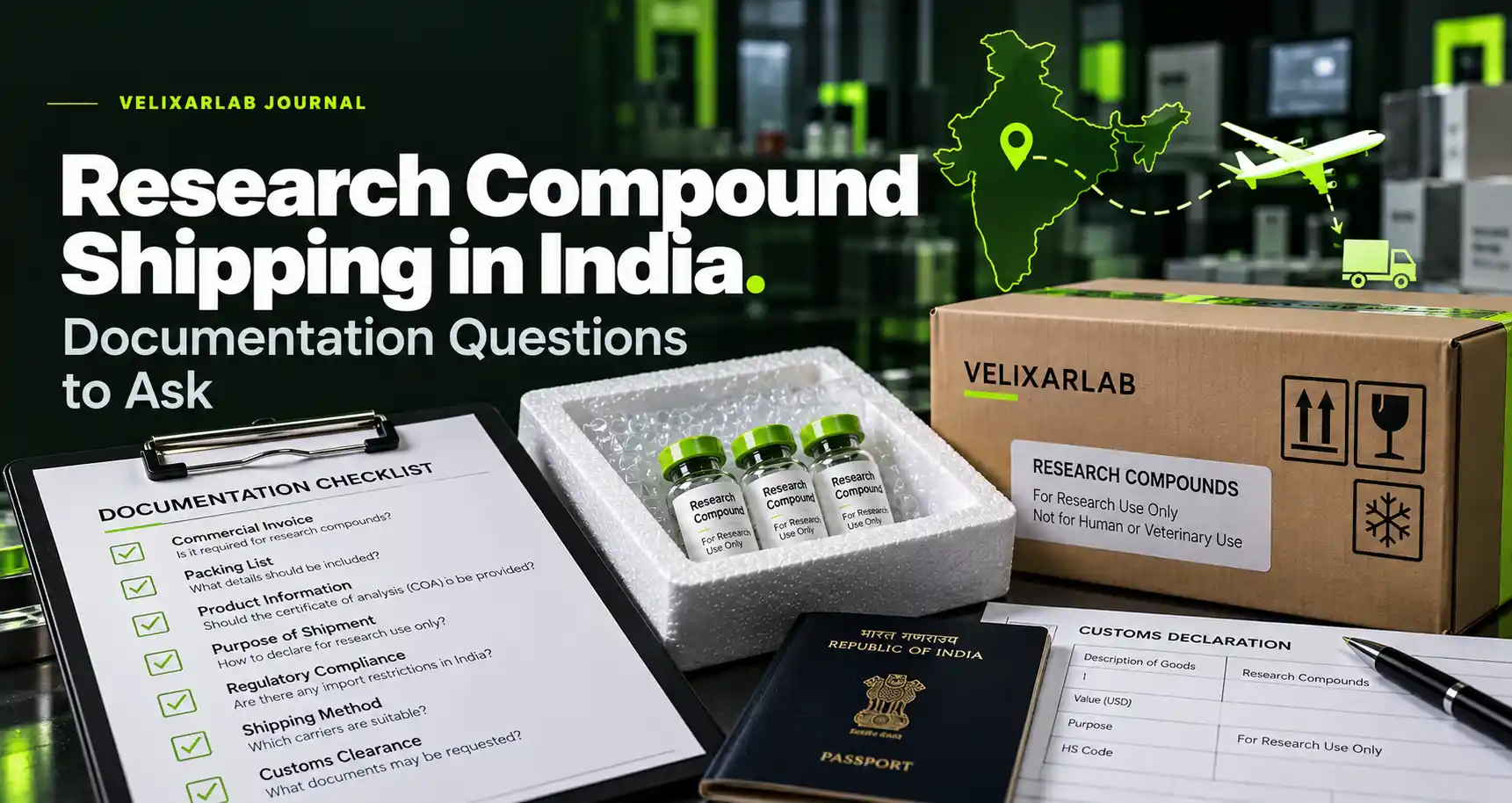
- Research compound shipping India decisions start with the correct chemical description and supplier documentation, not a courier’s delivery estimate.
- An invoice, packing list and tracking record do different jobs; keep each linked to the consignment.
- Label information should match the actual product, net amount and supplier or consignee details where applicable.
- Temperature-sensitive materials require product-specific shipping requirements and evidence, not generic “cold chain” claims. Compare the current shipping policy and contact the team for material-specific documentation.
- Record transport condition and delivery time immediately on arrival.
- Imported research chemicals may require classification or permissions that differ from domestic shipments; seek institution-specific customs and regulatory review.
- Hold discrepant or damaged samples for an authorized receiving decision and preserve all correspondence.
Why Shipping Paperwork Matters to Research Quality
Shipping is often treated as a checkout step, yet the journey between dispatch and a laboratory’s receiving desk can affect sample traceability and physical condition. A research compound shipping India documentation process connects the order, actual parcel, material identity, handling conditions and local inventory record.
This article is designed for institutional buyers and suppliers, not for bypassing shipping restrictions or making unverified assurances about delivery speed. The same compound can face different transport or import requirements depending on its classification, packaging, hazardous properties and intended use. Each consignment needs its own factual review.
Every research compound shipping India record should keep material identity separate from assumptions about courier temperature control.
Ask the Supplier Five Questions Before Dispatch
What exactly is being shipped?
Request the full compound name, relevant chemical form, number of containers, nominal quantity, lot identifier when available and applicable safety documentation. NAD+, for example, is a dinucleotide coenzyme rather than a peptide, despite sometimes appearing in a shared research catalogue. A broad category label may be insufficient for customs or technical review.
In research compound shipping India records, distinguish product description from claims about laboratory quality. A label saying “research use only” does not establish the substance’s legal classification, whether import rules apply, or whether an individual package meets quality specifications.
A research compound shipping India checklist is particularly helpful when one carton contains several chemical forms or lots.
What paperwork is included?
Ask for the invoice, packing list, relevant lot documentation and shipment reference. An invoice describes the transaction; a packing list documents the physical contents; a COA documents tests on an identified sample. None should automatically substitute for another.
Are special conditions required?
If the supplier identifies a controlled shipping temperature or a hazardous classification, request the product-specific basis, appropriate packaging description and any required carrier acceptance confirmation. Do not assume that all lyophilised peptides require the same cold-chain temperature or that ice packs prove the full journey was controlled.
Who can answer a delivery exception?
Record the designated supplier contact, institutional receiving representative and process for investigating a lost, damaged or temperature-excursion shipment. For research compound shipping India, the most useful service guarantee is a clear process for evidence and correction, not an unsupported claim that problems never happen.
What will happen at receipt?
Agree how the laboratory will reconcile product, lot, documentation and condition before releasing material to inventory. If the parcel arrives outside staffed hours, ensure the institution has an appropriate receiving plan.
India Domestic Shipment vs Imported Research Material
A domestic shipment and an imported consignment may involve different transport, invoice, regulatory and customs questions. Product classification and permission requirements should not be inferred from the words “chemical,” “peptide,” or “research only.” The institution’s responsible staff should check the actual product’s status and relevant official requirements before arranging an import.
For research compound shipping India import questions, the Directorate General of Foreign Trade (DGFT) publishes import policy information, while CDSCO provides information relevant to investigational new drugs and regulated activities. The correct legal pathway depends on substance, activity and classification. This article cannot issue a clearance decision or imply one permit applies to every research compound.
Questions for the institution’s customs team
- What is the precise chemical description and proposed HS/ITC(HS) classification?
- Is the item subject to any specific restriction, permit or declaration requirement?
- Which consignee and end-use information are required?
- Are there carrier-specific packaging and documentation obligations?
- Which records will be retained for audit after delivery?
The purpose of research compound shipping India documentation is to make these issues visible early, not to advise false declarations or vague labeling.
Transport Evidence: Conditions, Tracking and Custody
A tracking ID is not temperature proof
Courier tracking can demonstrate some location and scan events. It does not automatically show that a parcel remained within a specified temperature interval. If temperature matters, a suitable monitoring plan or product-specific stability evidence is needed. Different materials may tolerate different exposures.
The WHO sample transport guidance emphasizes safe packaging, timely transport and suitable conditions with corrective action when material integrity may be compromised. Its laboratory quality principles are useful here, although they do not themselves prescribe import permissions for a particular chemical.
For research compound shipping India, customs documentation should use accurate chemical descriptions rather than generic marketing labels.
Preserve custody and exception records
Keep consignment number, dispatch time, delivery date/time, package condition, relevant temperature evidence, receiver identity and document versions together. If a box is crushed or the consignee differs from the paperwork, log the issue before separating the contents from their original packaging.
For research compound shipping India, a chain-of-custody record supports reconstruction of who held a material and when. It does not, by itself, prove molecular identity or make an invalid COA applicable to a different batch.
Good research compound shipping India practice ensures that a receiving exception remains linked to the affected physical container.
At the Laboratory: A Five-Step Receiving Procedure
- Check the order and packing list against the shipment count.
- Inspect outer packaging, inner containers and label legibility.
- Record lot numbers, tracking and as-received conditions.
- Match available COAs and technical specifications to the actual material.
- Accept, hold or escalate discrepancies under the institution’s procedure, then document storage transfer.
| Receiving item | Record or question |
| Courier evidence | Tracking number and delivery timestamp |
| Actual contents | Product, lot, form, count, labeled amount |
| Package integrity | Seal status, moisture or physical damage |
| Temperature | Relevant indicator or logger evidence if required |
| Documents | Invoice, packing list, available COA and SDS |
| Disposition | Accepted, held, rejected or awaiting clarification |
This procedure makes research compound shipping India accountability more practical for a busy university or private analytical facility. It is not a substitute for a full institutional SOP.
Three Fictional Shipping Exceptions
Case A: Correct order, wrong lot code. A supplier invoice lists lot RC-26-05, but the vial shows RC-26-06. The laboratory records the mismatch and requests a controlled reconciliation rather than rewriting the label.
Case B: Unknown temperature history. A temperature-sensitive item arrives late with no logger evidence. Staff record the facts and request stability justification or a replacement according to approved criteria; they do not claim the material is automatically ruined or automatically safe.
Case C: Imported material with incomplete classification. The purchasing team sees a generic “research sample” declaration without the actual chemical identifier. The institution requests accurate classification and applicable import advice before proceeding. It must not invent an HS code or claim permission that has not been obtained.
These examples show how research compound shipping India teams should document uncertainty instead of concealing it.
VelixarLab Research Documentation Enquiries
The VelixarLab research catalogue identifies currently described materials. To ask about available lot documents, shipment records or product-specific handling information, contact VelixarLab. Website statements about shipping or testing should be verified for the actual order; this article does not independently confirm any courier, stability or regulatory guarantee.
FAQs
Does “research use only” automatically allow importing a compound into India?
No. Classification, intended use, transaction and applicable rules still need a product-specific determination.
Do all lyophilised peptides need the same cold chain?
No. Stability depends on the specific material and available evidence. A universal shipping temperature should not be assumed.
Is the courier tracking page a chain-of-custody record?
It is one source of transport evidence, but a complete institutional record may also require receiver, lot and condition information.
What if the packing list and vial labels disagree?
Record the original identifiers and seek supplier clarification; do not edit records to manufacture a match.
Can a damaged outer carton mean the peptide failed analytically?
Not automatically. It triggers inspection and qualified assessment of inner package and product integrity.
Conclusion
Responsible research compound shipping India practices connect accurate descriptions, applicable permissions, traceable paperwork and a documented arrival inspection. Quality-sensitive decisions should be based on actual conditions and material-specific requirements rather than generic assurances. Research compounds are not for human or animal consumption.