
How to Label and Track Peptide Samples in a Laboratory
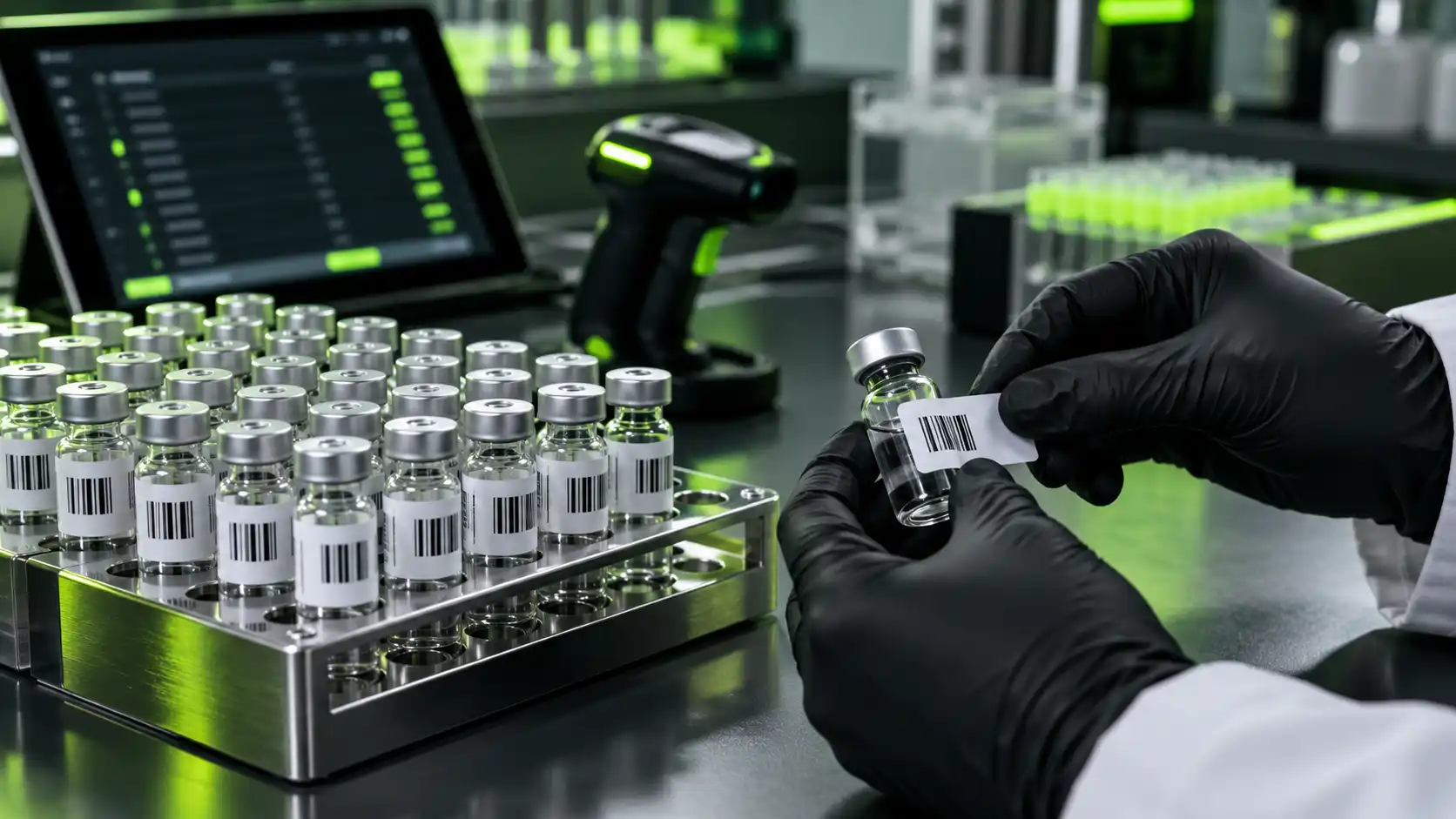
- Use a unique, legible local sample identifier on every primary container and keep its record searchable.
- Preserve the original supplier lot even when the laboratory assigns its own accession or inventory number.
- Prepared solutions and aliquots should receive child IDs that point back to the parent sample.
- Record preparation or freeze dates when applicable; do not equate them with validated expiry dates.
- Capture storage location, condition, movement history and temperature deviations according to the protocol.
- Keep original labels, COAs, receipt notes and disposal or transfer records linked to the sample.
- Never silently relabel a mismatch; retain the original record and use a documented exception workflow.
An unlabeled tube in a freezer may contain the correct compound yet be unusable for a defensible study. A peptide sample labeling guide should answer which material is in each container, where it came from, how it was prepared, and what happened before the measurement. Traceability is created through identifiers and records—not by remembering the color of a cap.
The minimum principle is straightforward: give every research container an unambiguous local ID, preserve the source lot, and ensure child aliquots or derivative solutions remain linked to the original material. A good peptide sample labeling guide also specifies what to do when information is missing rather than inventing a label after the event.
Peptide Sample Labeling Guide: Reproducibility and Identity
A laboratory result is only interpretable when the material used in the experiment can be identified. Different lots may differ in measurable content, impurity profile or prior storage. If sample identity becomes uncertain, the laboratory may be unable to reproduce a result or investigate an unexpected observation.
The explains laboratory quality principles, including records and process control. Its focus is health laboratories, not research-peptide-specific legislation, but its documentation approach provides useful general practice.
Peptide Sample Labeling Guide: Essential Label Fields
| Field | Example (fictional) | Purpose |
|---|---|---|
| Local sample ID | VEL-LAB-26-0038 | Unique internal reference |
| Material | Research peptide X | Quick identification |
| Supplier lot | LOT-26-118 | Upstream traceability |
| Prepared date | 2026-10-20 | Chronology if prepared |
| Operator initials | AK | Accountable record |
| Storage location | Freezer-2 / Rack-C / Box-5 | Retrieval |
| Child aliquot | 0038-A02 | Parent-child tracking |
The above values are fictional examples, not VelixarLab batch identifiers. In a tightly controlled inventory, a small label can carry a short unique ID and machine-readable code while the electronic record contains the full chemical description, supplier lot, quantity, preparation history and safety documentation.
Do not replace the supplier lot with the local ID
The supplier batch and the laboratory inventory code serve different purposes. Record both and preserve their mapping. A packaging lot, upstream bulk lot and laboratory accession ID may differ legitimately; their relationship should be supported by original paperwork.
Label information must survive the storage environment
Use materials and ink or printing processes suitable for the institution’s expected temperature and exposure conditions. Labels that detach, fade or become unreadable break the traceability chain. Confirm compatibility with the container and planned storage rather than assuming every commercial sticker works in a cold environment.
Parent Samples, Child Aliquots and Prepared Solutions
A source vial can be divided into several tracked containers. Each child should receive a unique identifier that cannot be confused with its siblings. The record links the child to its parent, includes dates and operators, and records the approved preparation procedure reference when applicable.
A simple parent-child ID pattern
For illustration, source ID VEL-LAB-26-0038 could produce child IDs VEL-LAB-26-0038-A01 and VEL-LAB-26-0038-A02. The pattern matters less than consistency and uniqueness. Do not infer that an aliquot has the same stability period or composition unless the documented procedure and supporting evidence justify that conclusion.
Freeze date is not an expiry date
A date indicating when a sample was frozen or prepared supports chronology. It does not establish that the sample is safe, stable or valid until a calculated calendar date. A permitted-use date or reassessment interval should reflect product-specific evidence and an approved laboratory protocol.
Create a Research Sample Record That Complements the Label
The linked electronic laboratory notebook or inventory record should include source supplier, original label photos when allowed, certificate and report identifiers, declared and measured quantities when applicable, condition at receipt, assigned sample ID, approved storage specification, transfers, deviations and final disposition.
For the peptide sample labeling guide to support auditability, maintain a record of edits or corrections with who made the change and why. An overwritten lot number with no retained history can undermine a later investigation. Keep the original observation and the documented resolution.
Peptide Sample Labeling Guide: Controlled Storage and Tracking
The label should map to a physical location that staff can actually find. A useful locator may include building, room, unit, rack, box and position. When the sample moves between sites or storage units, record movement time and responsible operator in the institutional system; update location without destroying past history.
Temperature excursions and custody events
If a protocol requires monitoring, tie temperature records to the relevant storage unit and review period. A deviation should identify affected samples, observed condition, time range and decision. A courier handoff or temporary bench transfer can be documented through the same chain-of-custody concept.
Disposal and depleted sample status
Close out containers when discarded, depleted or transferred. Record the reason and date, then prevent an obsolete inventory entry from showing stock that no longer exists. Institutional safety and waste policies govern the actual disposal process.
Receiving Checklist for India Laboratories
- Check the product description and quantity on purchase, packing and physical labels.
- Copy source lot and any packaging-lot identifiers exactly, including punctuation or leading zeros.
- Check the available COA and sample-to-report relationship before accepting analytical claims.
- Create the local accession or inventory identifier and link it to original documents.
- Record receipt condition, date, operator and initial storage location.
- Escalate damaged seals, missing labels or contradictory identifiers for review.
- Retain the final disposition of the receiving decision.
For peptide sample labeling guide procedures used in India, verify relevant institutional chemical safety and procurement requirements rather than treating one international template as local legislation. When analytical laboratory accreditation is relevant, the explains how to check laboratory-specific scope.
A Fictional Labeling Error and Its Resolution
An incoming vial reads supplier lot B-0261 but the electronic record is typed B-026I, substituting the letter I for the digit 1. Before any related analysis, staff notice the discrepancy, retain the original photo, correct the record through a controlled amendment and document the reviewer. That is more defensible than changing the vial label silently or guessing which version was right.
This example illustrates the strength of a peptide sample labeling guide: it provides a route to resolve errors while retaining the documentary history.
How VelixarLab Documentation Fits the Record
The is a starting point for product identification, and the provides general research context. A laboratory should still obtain actual batch documentation, capture its own received sample ID and maintain local handling records. The product page cannot know which freezer rack or child aliquot the institution ultimately uses.
For product-specific documentation, with the material and lot reference. The peptide sample labeling guide principles help buyers ask precise questions without relying on unverifiable assumptions about supplier testing or shipment history.
A Practical Audit Trail for a Multi-User Laboratory
Imagine three researchers sharing the same incoming peptide lot. One staff member receives and registers the original vial, another generates derivative aliquots, and a third runs an analytical study. The peptide sample labeling guide approach requires every new container and result to carry a reference that leads back to the original source record. Staff should be able to reconstruct this chain without contacting the person who first opened the shipment.
Use an electronic change history where available. If a handwritten log is used, institutional procedures should state how to correct errors without obscuring the original entry. Barcodes can improve speed, but a barcode that opens an incorrect database record is not good traceability. Periodic spot checks should compare the stored physical label with the electronic identity and current location.
Link Each Result to the Exact Research Sample
Analytical data files, lab notebook entries and experiment IDs should contain the local sample or child aliquot identifier. Otherwise a laboratory may be able to find a purity report yet remain unable to show which vial was analysed. The peptide sample labeling guide should require the analytical method reference, run date, operator and relevant sample ID in the resulting record, following institutional policy.
If two aliquots from the same parent have different handling histories, retain separate records. It is not safe to assume that they remain equivalent after one is warmed, transported or prepared differently. Proper identity tracking creates the possibility of investigating such differences; it does not establish stability by itself.
Periodic Inventory Review and Exception Handling
A practical laboratory should reconcile inventory records with physical containers at defined intervals appropriate to its risk level. Flag missing labels, duplicate IDs, apparently depleted stock, unexpected transfers and mismatched storage positions. Hold uncertain samples until reconciled; never re-create missing provenance from memory. This final peptide sample labeling guide check turns daily recordkeeping into a sustainable system rather than a one-time labeling exercise.
Frequently Asked Questions
What is the minimum information on a small sample label?
At least a unique identifier that maps to a controlled record; add material and relevant safety or handling information according to the institution’s system.
Are a batch number and sample ID the same?
Not always. The supplier batch identifies source material, while the local sample ID identifies the institution’s particular container or record.
Should every aliquot have a different identifier?
Yes, if it is tracked as a distinct container. The child identifier should point back to a parent sample and source lot.
Does freeze date establish an expiry date?
No. It records an event. Stability or retest decisions require suitable evidence and an approved protocol.
What if a label is unreadable?
Preserve the container and available records, hold it under local procedures and attempt documented identification; do not guess.
Why retain a disposal record?
It closes the inventory history and prevents later confusion about whether a sample was used, transferred or discarded.
A peptide sample labeling guide becomes useful when it lets an independent colleague find the actual vial, source lot, derivative sample and corresponding experimental data.
A peptide sample labeling guide must cover both new labels and controlled corrections; preserving the original record is critical when identifiers are disputed.
For a peptide sample labeling guide to support reproducibility, the institution must also maintain movement and disposal records until the inventory history is complete.
When a peptide sample labeling guide is used by multiple teams, common identifiers are more reliable than personal naming conventions or unregistered shortcuts.
A peptide sample labeling guide should also specify the expected location of the certificate and the laboratory record rather than merely telling staff to keep documentation.
Periodic review of the peptide sample labeling guide can identify recurring mistakes in transcription, child aliquot numbering and inventory updates.
Conclusion
A peptide sample labeling guide protects laboratory results by preserving the chain from supplier lot to local container, aliquot, experiment and final disposition. Use unique IDs, legible labels, controlled amendments and a searchable record. For the underlying supplier report and specifications, before accepting the material for research.
Technical Sources and Reading
- WHO Laboratory Quality Management System handbook
- FDA/ICH Q7 laboratory control and identification records (benchmark)
- NABL India FAQs and accredited scopes
Research-use notice: This is educational laboratory documentation content, not medical advice or instructions for human or animal use. Regulatory guidance cited for analytical best practice does not certify a specific supplier or imply every research reagent is governed by the same pharmaceutical standard.