
CJC-1295 With DAC vs Without DAC: Compound Identity Explained
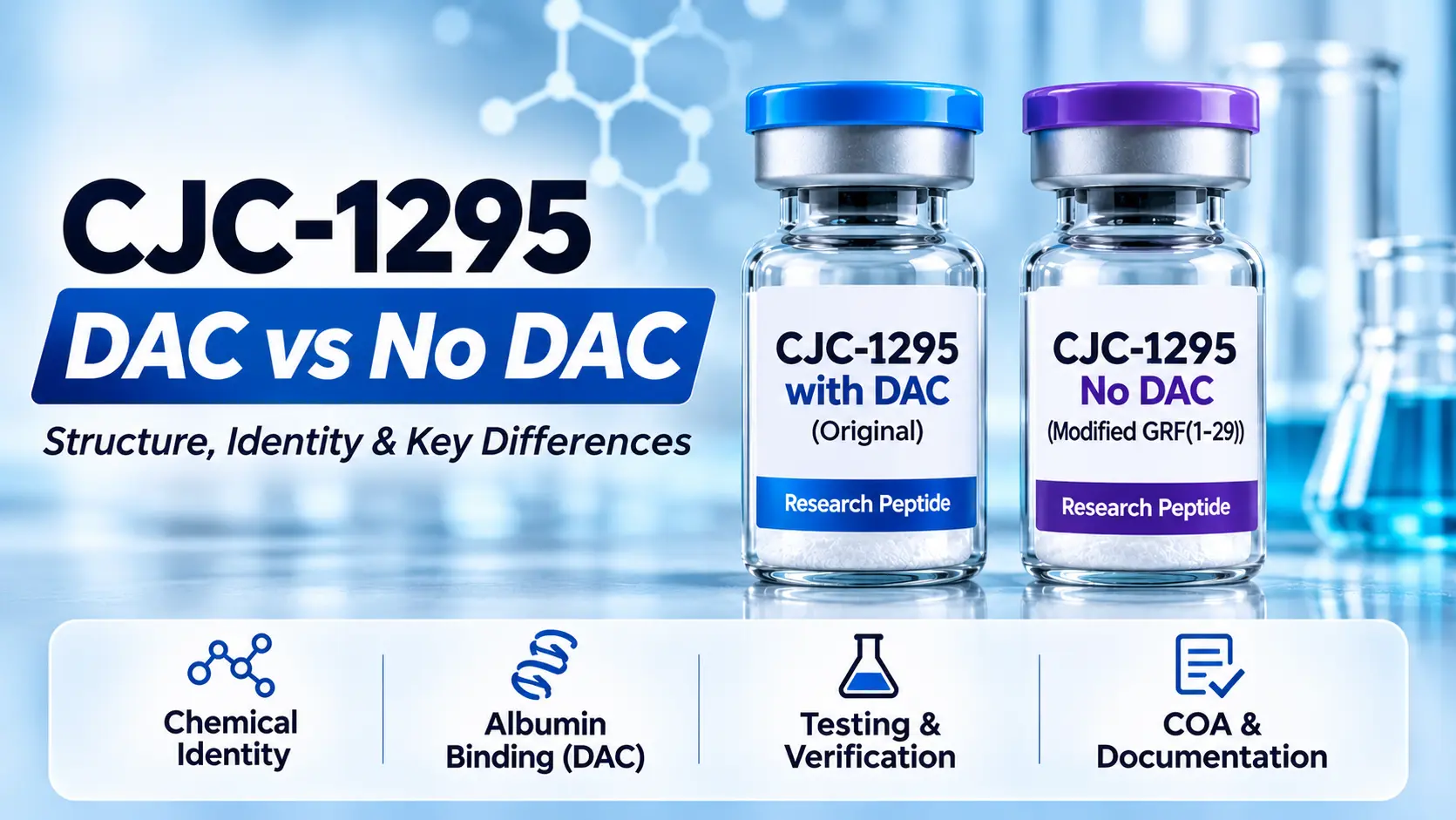
- These are not identical chemicals. DAC-bearing CJC-1295 includes an albumin-reactive modification; the peptide sold as “CJC-1295 no DAC” is usually modified GRF(1-29).
- DAC means Drug Affinity Complex. The structural addition was designed to associate with circulating albumin, changing the investigational compound’s pharmacokinetic behaviour.
- A shared name does not prove a shared sequence. Compare terminal chemistry, the precise analogue designation and the laboratory identity result.
- Do not transfer study results across structures. The published healthy-adult pharmacology work investigated the DAC-bearing molecule, not every product labelled “no DAC.”
- Mass spectrometry helps distinguish structures. A properly interpreted molecular-mass result supports, but does not alone completely establish, an identity assignment.
- Check blend labels separately. When the no-DAC form appears with ipamorelin, the quantity of each ingredient must be documented individually.
- For Indian laboratory procurement, request a lot-specific COA. Verify the report issuer, actual analytical methods and evidence linking the tested sample to the supplied material.
CJC 1295 DAC vs no DAC is fundamentally a question of *chemical identity*, not a decision about which product is “stronger.” The research name CJC-1295 originally referred to an analogue of growth hormone-releasing hormone (GHRH) carrying a Drug Affinity Complex. Commercial catalogues often use “CJC-1295 without DAC” to describe a related, but chemically distinct, tetrasubstituted GHRH(1-29) analogue also known as modified GRF(1-29).
For Indian analytical laboratories, understanding CJC 1295 DAC vs no DAC begins with the sequence and the terminal modifications. A supplier label alone cannot establish which compound is present, and a research paper about one analogue is not automatic evidence for the other. This guide explains the identity difference, the role of albumin binding, the testing evidence and the documentation questions that matter before accepting a research material.
Why the CJC-1295 Naming Convention Causes Confusion
When reviewing CJC 1295 DAC vs no DAC supplier terminology, look for the full chemical descriptor beside any convenient short name. A product code or abbreviated synonym may be useful for inventory, but it cannot replace residue identity, terminal modification and a reference to the applicable lot specification. See our research peptide datasheet guide for fields to verify.
The first 29 amino acids of human GHRH form an important reference fragment for this family of synthetic analogues. Researchers designed substitutions to alter chemical or enzymatic stability while retaining a GHRH-related core. Additional chemical attachment can change how a molecule associates with proteins in biological systems.
The CJC 1295 DAC vs no DAC comparison is confusing because the marketed “no DAC” name removes a feature from a term historically associated with the DAC-containing compound. “Modified GRF(1-29)” is a more discriminating identity description for the 29-residue analogue without the albumin-reactive extension. The supplier’s exact structural specification remains decisive.
What Does DAC Mean?
DAC stands for *Drug Affinity Complex*. In the original research programme, a reactive group attached to the peptide was designed to bind serum albumin. Albumin attachment altered the investigational molecule’s apparent residence time in circulation. This is chemical and pharmacokinetic context, not a recommendation for administration or proof of clinical benefit.
What Is Modified GRF(1-29)?
Modified GRF(1-29), sometimes called tetrasubstituted GRF(1-29), is generally described as a 29-amino-acid, C-terminally amidated analogue. Its substitutions at selected positions distinguish it from native GHRH(1-29). It lacks the C-terminal albumin-reactive DAC modification of original CJC-1295. Because marketplace naming varies, a laboratory should request the actual sequence and terminal-group specification rather than relying on an informal alias.
CJC 1295 DAC vs No DAC: Comparison of Chemical Identity
Another CJC 1295 DAC vs no DAC checkpoint is whether the molecular formula refers to the unmodified core, the terminally extended molecule or a salt form. Laboratories sometimes compare a free-base theoretical mass with a salt-labelled product, which creates apparent discrepancies unless the measurement basis is defined.
| Attribute | CJC-1295 with DAC | Modified GRF(1-29), commonly called no DAC |
|---|---|---|
| Peptide family | GHRH-related research analogue | GHRH-related research analogue |
| Core | Modified GHRH(1-29) | Modified GHRH(1-29) |
| Albumin-reactive addition | Present in original DAC compound | Absent by definition |
| Common name issue | Often called simply CJC-1295 | Often marketed as CJC-1295 no DAC |
| Identity confirmation | Sequence, terminal chemistry, relevant mass evidence | Sequence, terminal chemistry, relevant mass evidence |
| Study transferability | Findings specific to tested DAC material | Cannot inherit DAC findings by name alone |
This CJC 1295 DAC vs no DAC table is a guide to the distinctions that should appear in a research specification. It does not verify the composition of any retailer’s vial. Salt forms, reported molecular masses and particular synthetic preparations also need to be stated on the supplier’s technical documents.
What Published Studies Actually Investigated
The CJC 1295 DAC vs no DAC evidence review should also record the publication date and the actual study material. A clinical pharmacology paper involving albumin conjugation can inform chemical context; it cannot stand in for an independent experiment using a DAC-free commercial catalogue item.
A 2005 paper by Jetté and colleagues identified CJC-1295 as a long-lasting human GRF analogue in an albumin-bioconjugation research programme. The experiment specifically evaluated the albumin-linking strategy, including its effects in rat models. The supports the structural rationale without establishing universal properties for unrelated commercial materials.
A 2006 investigational study of DAC-bearing CJC-1295 in healthy adults reported pharmacokinetic and hormonal measurements in two randomised, placebo-controlled trials. The work should be read as an early clinical pharmacology investigation involving that defined molecule, not proof of medical efficacy or long-term safety. It cannot be used to assign an identical profile to modified GRF(1-29). See the original 2006 CJC-1295 clinical pharmacology study on PubMed.
Why the Results Cannot Be Pooled Uncritically
For CJC 1295 DAC vs no DAC, the shared biological target does not eliminate structural differences. The presence or absence of the reactive extension changes what molecule was tested. Pharmacokinetic values depend on the study preparation, measurement method and population. Published study conditions should remain attached to the results.
More importantly, a result from a controlled investigational study cannot validate a supplier’s batch merely because the same commercial name appears on the label. Separate chemistry and quality records are required.
How to Verify Compound Identity in an Indian Laboratory
For a reproducible CJC 1295 DAC vs no DAC material review, retain a copy of the chemical specification, original COA and any issuer verification response together. If the report describes only an ambiguous nickname, request a written clarification before coding the lot as a distinct chemical identity.
A laboratory evaluating CJC 1295 DAC vs no DAC should request the declared sequence, stereochemistry, C-terminal status and any covalently attached modifying group. Compare these descriptions with the identity evidence attached to the actual product lot. Different analytical techniques answer different questions. Our guide to what peptide identity tests can and cannot verify explains their respective limitations.
Chromatography and Mass Spectrometry
A suitable HPLC method may describe the separation of peptide-related components. A main-peak area percentage does not demonstrate that the peptide has the correct terminal chemistry. Electrospray or other suitable mass spectrometry can support an assignment by comparing observed ion patterns with the theoretical molecule. Charge states and counterions need proper interpretation, and mass agreement alone may not settle every possible structural ambiguity. Read our peptide mass spectrometry and molecular identity guide for more context.
The separates identity, impurities and assay objectives. It is a useful methodological reference, not automatic evidence that a research supplier meets pharmaceutical quality regulations.
Match the Batch to the Report
At a minimum, compare the product description, lot identifier, laboratory sample ID, report number, result date and method. If the test report uses a different identifier, request the documented cross-reference to the supplied lot. Authenticity should be checked through the issuing laboratory where necessary.
How the No-DAC Form Appears in a Research Blend
For CJC 1295 DAC vs no DAC research planning, the presence of a second peptide can complicate chromatographic interpretation and document requirements. A lab should ask whether a report describes the finished blend, one upstream ingredient or a representative sample from a different manufacturing lot.
VelixarLab lists a CJC-1295 No DAC + Ipamorelin research blend. Its currently displayed quantity is 10 mg total. The public product page does not identify the proportion or separate milligram amount of each component. Therefore CJC 1295 DAC vs no DAC evidence cannot be resolved by assuming this blend contains equal quantities or by assigning it a DAC-bearing structure.
An institution evaluating that product should request component names, individual quantities or permitted ranges, applicable reference standards and supporting identity and assay results for both peptides. A single “purity” headline is insufficient to establish blend composition. Our separate guide, CJC-1295 and Ipamorelin Research Blend: Reading the Specification, addresses those documentation questions without duplicating this compound-identity article.
Common Documentation Red Flags
CJC 1295 DAC vs no DAC nomenclature is a useful internal quality-audit case study: the acceptance decision should cite the precise field that establishes identity. A statement such as “supplier says no DAC” is weaker than an independently interpretable structure or method-specific identity result.
- A certificate saying only “CJC-1295” with no structural designation.
- The same molecular-mass claim copied across DAC and no-DAC products without an explanation.
- A chromatogram presented as proof of the albumin-binding terminal group.
- Research about the DAC version used as evidence for a different commercial no-DAC preparation.
- A blend with only total vial mass and no declared component composition.
- A report number or batch number that does not trace to the supplied container.
For CJC 1295 DAC vs no DAC, each issue should prompt a precise documentation request, not an assumption that every supplier is mislabelling material. Our peptide COA red flags guide explains how to identify missing or unverifiable records.
Frequently Asked Questions
The broader lesson of CJC 1295 DAC vs no DAC is that structural terms should travel with every experiment, sample label and data file. A team that preserves those terms can revisit older experiments without needing to reconstruct the identity from an informal product nickname.
Is CJC-1295 Without DAC the Same as Modified GRF(1-29)?
Commercial catalogues commonly use those names for the same intended analogue. For reliable research, confirm the actual sequence, terminal chemistry and batch-specific identity report rather than assuming every listing is identical.
Does DAC Stand for Drug Affinity Complex?
Yes. It describes the albumin-binding chemical design investigated in original CJC-1295 studies.
Are Both Compounds the Same Molecular Weight?
No. Adding an albumin-reactive extension changes the chemical structure and therefore the theoretical mass. Exact reported mass also depends on the chemical entity being specified.
Can the DAC Human Study Prove No-DAC Clinical Benefits?
No. Results relate to the studied investigational DAC-containing preparation. They do not prove clinical effects or safety for modified GRF(1-29).
Does an HPLC Purity Report Prove the Correct Form?
No. Chromatographic area purity and chemical identity are separate questions, and terminal modification may require complementary evidence.
What Should a Blend Certificate Declare?
The identity, actual quantity or composition basis and relevant analytical results for each component, together with sample-to-lot traceability.
Conclusion: Start With the Actual Molecule
The practical lesson from CJC 1295 DAC vs no DAC is that similarity of names does not guarantee similarity of structures, laboratory results or biological evidence. Identify the intended molecular form and obtain appropriate batch records before interpreting published work or comparing suppliers.
To enquire about the documented identity of a specific VelixarLab research material, review the and with your laboratory’s technical documentation requirements.
*Research-use notice: This guide covers chemical identification and research literature, not human dosing, administration or treatment. Research materials are not intended for human or animal consumption.*
References — scientific and technical sources
- Jetté et al. (2005), identification of the albumin-linked long-lasting analogue
- Teichman et al. (2006), investigational DAC-bearing CJC-1295 in healthy adults
- ICH Q2(R2), analytical-method validation principles