
CJC-1295 and Ipamorelin Research Blend | Reading the Specification
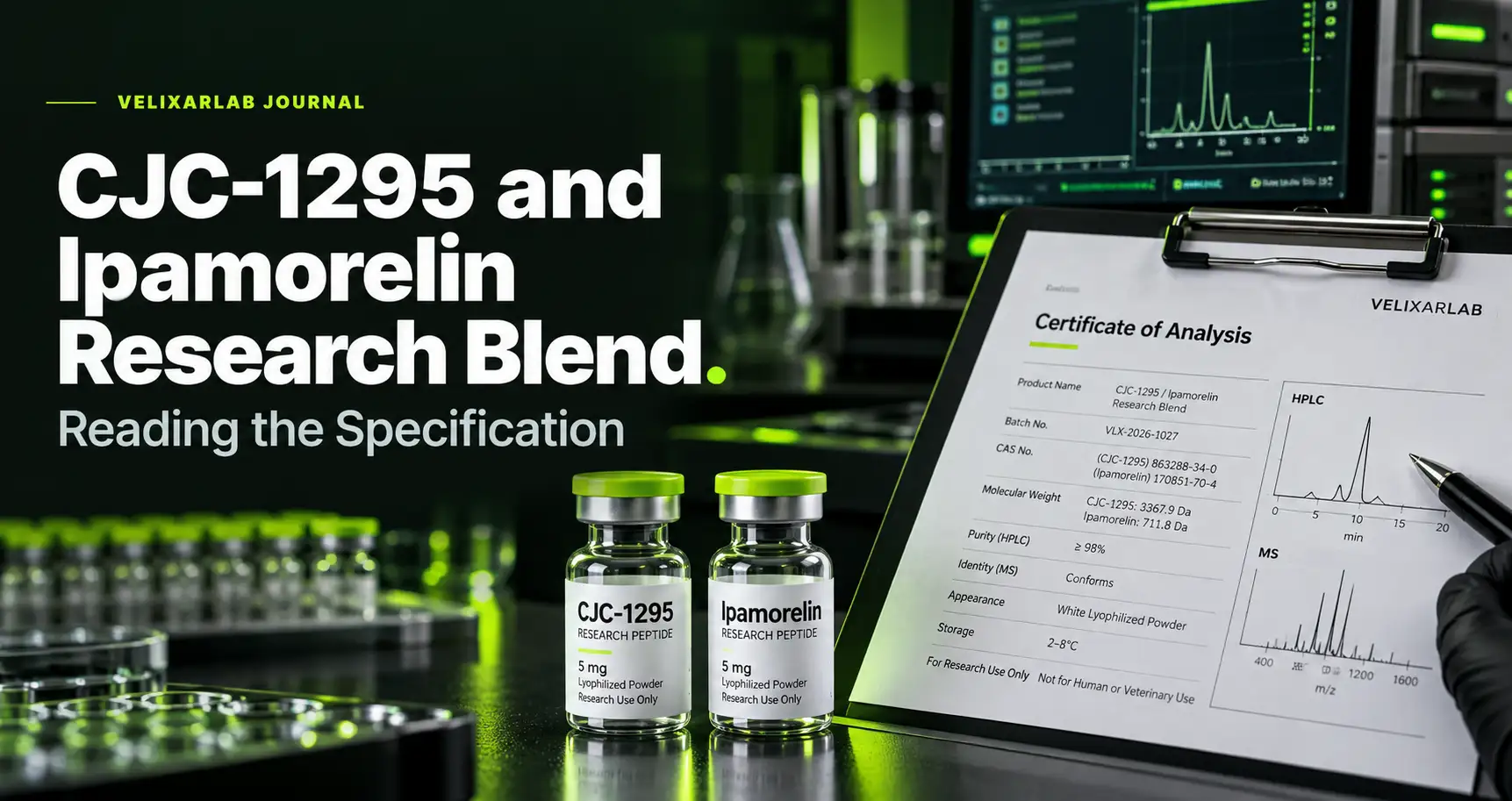
- A blend contains two named analytes. CJC-1295-related material and ipamorelin must each be identified, not assumed from a shared label.
- “10 mg blend” is a total amount, not a component ratio. It does not tell a researcher whether each ingredient contributes 5 mg, 7 mg or some other amount.
- The DAC status is critical. A listing that names “no DAC” should be checked against the intended modified GRF(1-29) identity rather than presumed to describe the DAC-bearing compound.
- Each component may need its own assay. A single chromatographic peak-area percentage cannot prove that both peptides meet their specifications.
- Identity and net amount are separate. MS signals support assignment of species; a suitable calibrated quantitative method is required for reliable mass per component.
- Batch traceability links physical vials to the report. The lot, submitted sample, assay method and issued certificate need a recorded relationship.
- Indian laboratories should ask for the missing fields. VelixarLab’s current 10 mg public listing does not specify the component ratio, so do not guess it.
A two-peptide blend is harder to verify than a single reagent. CJC 1295 Ipamorelin blend composition involves two different chemical species, their relative quantities, the total vial amount and the analytical methods used to support the label. A headline statement such as “10 mg, 99% purity” does not answer all these questions.
For an Indian quality-control or procurement team, CJC 1295 Ipamorelin blend composition should be reviewed as a quantitative specification. The aim is not to interpret the blend as a clinical intervention. It is to establish what material was supplied and what the actual report can justify.
What Are the Two Research Compounds?
For CJC 1295 Ipamorelin blend composition, identity starts with two separate entries in the specification even if the material arrives in one vial. Each entry should name the compound, relevant chemical form, intended amount and reference method, avoiding an ambiguous umbrella name.
The CJC-1295 No-DAC Component
The expression “CJC-1295 no DAC” is commonly used for modified GRF(1-29), a GHRH-related research analogue that lacks the albumin-reactive Drug Affinity Complex used in original CJC-1295. Because commercial naming is inconsistent, the precise sequence and modifications matter more than the short name. The DAC-bearing structure and modified GRF(1-29) are not interchangeable chemical identities.
Ipamorelin Identity
Ipamorelin is a synthetic pentapeptide discussed in experimental literature as a growth-hormone secretagogue. Its early characterization appears in . That paper describes a defined molecule with its own sequence and research programme. Those findings do not validate a commercial blend or establish clinical suitability.
For CJC 1295 Ipamorelin blend composition, the five-residue ipamorelin component must be confirmed independently from the longer GRF analogue. Different masses, chromatography retention times and detector responses mean the two signals should not be confused with one another.
Three Numbers That Every Blend Specification Should Explain
A good CJC 1295 Ipamorelin blend composition sheet must also say whether ratios are expressed on a mass, molar or other defined basis. Equal mass amounts do not necessarily mean equal numbers of molecules when the components have substantially different molecular masses.
| Field | Meaning | What not to assume |
|---|---|---|
| Total blend mass | Declared combined material amount on a specified reporting basis | That the two components are equal |
| Individual component mass | Quantity of each named peptide | That it can be calculated from “purity” alone |
| Component ratio | Relative amounts, with defined basis | That it is the same in every product marketed under a similar name |
The difference between CJC 1295 Ipamorelin blend composition and a single-compound purity report is crucial: a reviewer needs the sum and its constituent parts. If the vial claims 10 mg total, that label is consistent with many possible ratios. None may be assigned without actual product specifications and a suitable analysis.
Fictional Example: Total Amount Is Not the Ratio
Imagine a hypothetical vial containing a labelled total of 10 mg of two peptide components. One fictional specification states 5 mg plus 5 mg; another states 6 mg plus 4 mg. Both sum to 10 mg. Their ratios, and therefore their chemical specifications, differ.
This is arithmetic, not a verified statement about VelixarLab India or another supplier. The point of CJC 1295 Ipamorelin blend composition is that both numbers need to be declared and, when required by the laboratory, verified using an appropriate method.
How to Read a Two-Component Certificate of Analysis
During CJC 1295 Ipamorelin blend composition review, a laboratory should determine whether a reported percentage represents chromatographic purity of a single analyte, area-normalised signal from the combined sample, or calibrated assay content. Each interpretation supports a different conclusion and should be documented explicitly.
A useful peptide blend COA should state the sample or lot identity, the name of each compound, the applicable specifications, the analytical method, measured results and the report issuer. A marketing certificate that provides only “blend purity: 99%” can obscure which component was actually measured.
Component-Specific Identity
An LC-MS method may support identification of the peptide species, provided chromatographic separation, charge states and theoretical masses are interpreted correctly. The result should be clear about which measured signal corresponds to modified GRF(1-29) and which to ipamorelin.
For CJC 1295 Ipamorelin blend composition, an expected mass match is supportive of identity but not an assay of the amount contained. An independent method may be needed to resolve closely related species or modifications.
Component-Specific Purity and Amount
Chromatographic peak-area purity typically describes detector responses under a given method. Since two peptides may have different UV absorptivity or ionization efficiency, their signal areas cannot automatically be converted into a mass ratio. Quantification should use suitable calibration or validated response factors for the specified components.
The explains why analytical identity, impurity profiling and quantitative assay are separate methodological purposes. CJC 1295 Ipamorelin blend composition depends on evidence that answers each required purpose.
A Sample COA Review Table
If a test report gives component identities but leaves individual amounts blank, the CJC 1295 Ipamorelin blend composition is only partially characterized. Record the limitation instead of back-calculating from peak heights, especially when the response factors or reference standards are not reported.
| Declared attribute | Example field a COA should contain | Verification question |
|---|---|---|
| CJC component | “Modified GRF(1-29), no DAC” | Does the method support this exact chemical identity? |
| Ipamorelin component | Named and separately identified | Is an appropriate reference or mass assignment supplied? |
| Component 1 mass | Actual mg/vial result | Was a suitable quantitative method used? |
| Component 2 mass | Actual mg/vial result | Is the value measured, not inferred from signal area? |
| Total mass | Defined sum/basis | Do reported values reconcile? |
| Ratio | Stated mass or molar basis | Is the claimed ratio verified on that basis? |
| Lot and report number | Unique traceable identifiers | Does the certificate belong to the received material? |
This table is a checklist, not a report of actual testing. CJC 1295 Ipamorelin blend composition remains unverified if its most important numerical fields are absent.
What the VelixarLab India Product Page Actually Says
Before purchasing, a qualified lab can send a targeted CJC 1295 Ipamorelin blend composition enquiry: “Please specify the individual peptide quantities, the reporting basis for the 10 mg label, the exact no-DAC chemical identity, and whether the COA assesses the finished mixture.” This gives the supplier a clear technical question.
VelixarLab India currently displays a listed as 10 mg in lyophilised form and described for laboratory research. The page says COA documentation is available, but the visible specification does not disclose the separate mg amount or ratio of the two constituents.
This is a specific, actionable improvement opportunity: add a verified component ratio and clarify whether 10 mg means combined net peptide amount, total powder amount or another basis. The site’s supplier testing claim should be checked against an actual lot-specific report before strengthening any article statement about material quality.
For CJC 1295 Ipamorelin blend composition, a researcher should request the missing component amounts directly through the , rather than assume the popular 50:50 formulation applies here. No unpublished product specification should be invented.
How to Reconcile a Vial Label With a Lab Report
For CJC 1295 Ipamorelin blend composition, an authentic upstream ingredient certificate is useful but not sufficient if the final mixture was prepared later. The institution should understand how final-blend homogeneity, mix records or samples were addressed within the supplier’s quality process.
Start with the exact product title and lot code on the physical vial. Check the packing slip and any supplier document linking that lot to the laboratory sample ID. Match the chemical descriptors to the certificate and inspect whether the assay reports separate measured results.
If a supplier repacked or combined upstream materials, CJC 1295 Ipamorelin blend composition may require additional records describing which component lots went into the final mix and which finished lot was sampled for analysis. A COA for only one individual peptide does not automatically certify the finished two-component blend.
Unexplained lot-code differences, an absent sample ID, or identical generic chromatograms across unrelated products warrant clarification. Do not modify a genuine report to make identifiers appear to agree.
Common Blend Testing Mistakes
An additional CJC 1295 Ipamorelin blend composition mistake is using a single molecular-weight figure for the mixture. A blend does not have one neutral molecular mass; each compound contributes its own expected ions, subject to the analytical method.
- Treating total nominal mass as the amount of *each* peptide.
- Assuming the word “CJC-1295” establishes whether DAC is present.
- Reporting a combined HPLC signal as a validated two-component purity measurement.
- Assuming an LC-MS identity check also measures each compound’s mg per vial.
- Using separate ingredient COAs without evidence about the mixed final batch.
- Comparing ratios from different methods without checking response factors and measurement units.
For CJC 1295 Ipamorelin blend composition, a concise uncertainty note is better than an unsupported numerical claim.
Frequently Asked Questions
Does a 10 mg Blend Mean 5 mg of Each Peptide?
No. The total does not specify allocation between components. Only a declared formulation and suitable confirmation can establish it.
Is No-DAC CJC-1295 the Same as the Original DAC Compound?
No. The no-DAC marketplace term generally refers to modified GRF(1-29), lacking the albumin-reactive DAC extension.
Can One Purity Percentage Prove Both Peptides Are Present?
No. The report should distinguish components and the tests performed on each.
Is LC-MS Enough to Verify the Blend Ratio?
Not automatically. Different species can generate different ion responses; a calibrated method appropriate for quantitative comparison is needed.
What Should a Lot-Specific Blend COA Contain?
A traceable lot and sample identity, separately identified ingredients, relevant quantitative results, methods, dates and issuing laboratory details.
Does a Supplier Product Listing Prove Clinical Benefits?
No. It describes a research product and cannot establish clinical safety, efficacy or authorization.
Conclusion: Verify Both Ingredients and the Reporting Basis
The priority in CJC 1295 Ipamorelin blend composition is an unambiguous specification: *which two chemical entities, how much of each, on which measurement basis, and supported by which lot-specific records?* That standard prevents a 10 mg label or a high purity headline from being mistaken for complete quantitative evidence.
To ask about the actual component ratio, consult the and for the research material under consideration.
*Research-use notice: This content describes laboratory composition assessment, not dosing, administration or therapeutic advice. Products discussed are intended for laboratory research only.*
References — scientific and technical sources
- Raun et al. (1998), structural and experimental identification of ipamorelin
- ICH Q2(R2), identity and quantitative assay method guidance
- Teichman et al. (2006), DAC-bearing CJC-1295 investigated separately