
How to Read a Research Peptide Certificate of Analysis (COA) in India
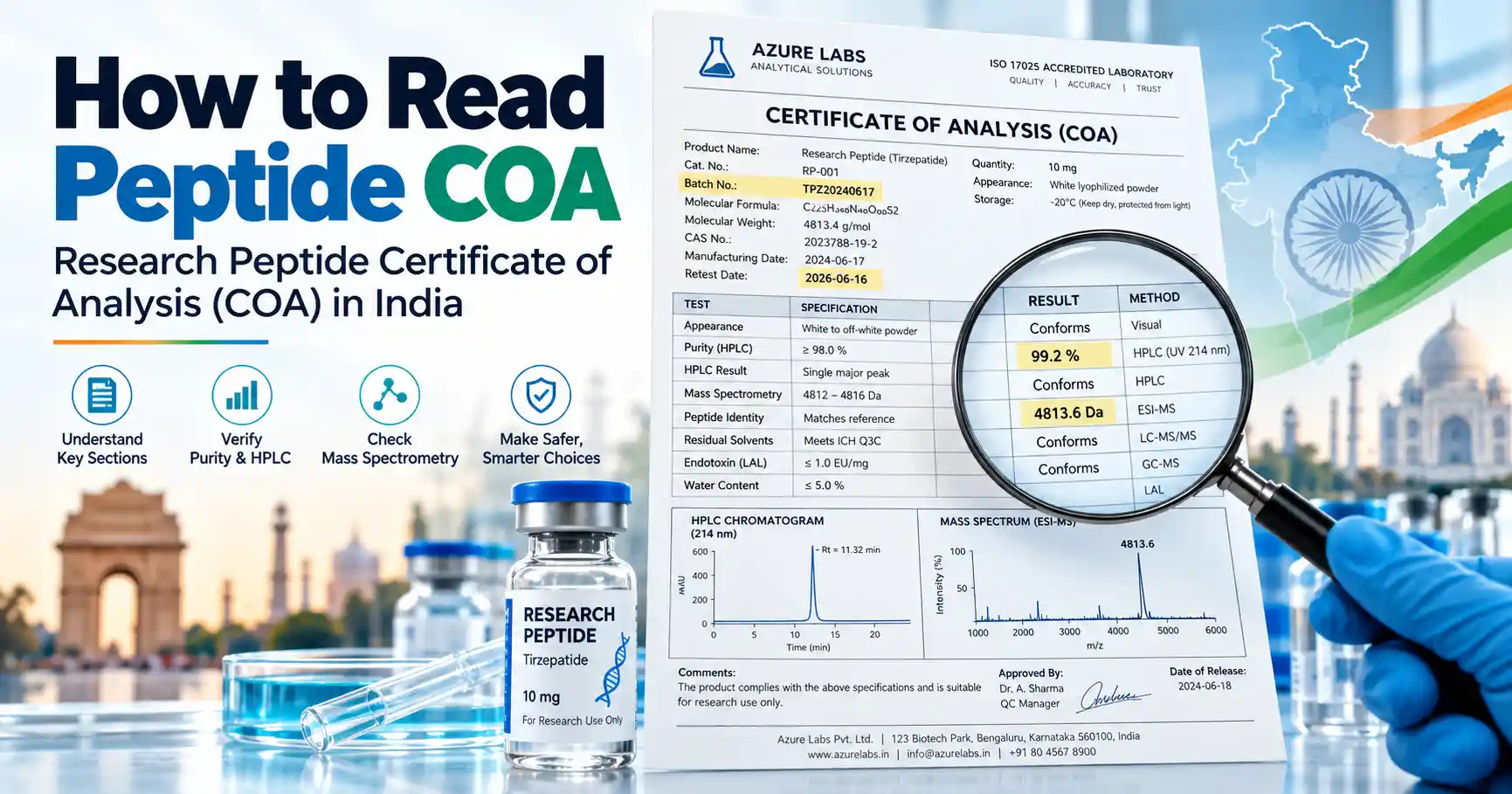
- Match the batch: A peptide COA should identify the material and a sample or lot number that can be connected to the supplied product.
- Check the issuing laboratory: Review the test report number, laboratory identity, report date, and a reliable route for checking report authenticity.
- Interpret HPLC carefully: An HPLC purity percentage usually describes relative chromatographic peak area; it is not automatically the percentage of peptide by weight.
- Separate identity from purity: Mass spectrometry or another suitable analytical method can provide evidence about the molecule’s identity.
- Read specifications alongside results: Learn how to read peptide COA specifications separately from measured results, with units and method details.
- Recognize missing evidence: No reported result for endotoxin, water content, sterility, or quantity means the certificate does not establish that characteristic.
- Verify in India: Check any claimed NABL accreditation and its test-specific scope before relying on it for laboratory procurement.
A certificate headed “99% pure” might look reassuring. Yet a high number says very little if the report belongs to another batch, the testing laboratory cannot be identified, or the method measures something different from what the purchaser needs. Understanding how to read peptide COA documents helps Indian research teams separate verifiable analytical evidence from product claims.
A research peptide Certificate of Analysis (COA) normally records tests performed on an identified material or sample, together with the analytical methods and reported findings. It does not, by itself, guarantee identity, sterility, medical safety, or suitability for a particular experiment.
Quick answer: To learn how to read peptide COA reports, start with the material name and batch number. Confirm who issued the report, when the sample was tested, and what each test actually measured. Compare the reported results with their stated specifications, then check any supporting chromatograms, spectra, and verification records.
What Is a Research Peptide Certificate of Analysis?
To understand how to read peptide COA evidence, start with a simple definition: it is a batch- or sample-specific analytical record. In research procurement, it offers a way to see which laboratory measurements were reported for a particular material rather than relying on a general statement about a product line.
This distinction is central to how to read peptide COA documentation: the certificate supports conclusions only about the sample and tests it describes. A generic specification sheet may list the properties a supplier aims to deliver, but the COA should record actual results for an identified lot or submitted sample.
For researchers studying how to read peptide COA certificates, documentation benchmarks matter. The FDA’s ICH Q7 guidance describes batch identification, test results, acceptance limits and authorized documentation for pharmaceutical ingredients. Those principles are a useful reference for checking report completeness, though they do not prove that any particular research material meets pharmaceutical GMP standards.
A Specification Is Not a Test Result
Suppose a supplier states that the acceptance criterion is HPLC purity ≥98.0%. That number is a specification. If the analytical report instead records 98.6% HPLC area, that is the measured result. “Pass” or “conforms” indicates the reported result meets the stated criterion, assuming the test was performed appropriately.
For laboratory staff learning how to read peptide COA tables, the most useful reading order is test → method → specification → result → units → interpretation. Never replace a missing result with the supplier’s advertised target.
How to Read a Peptide COA Reports: Seven Checks
1. Match the Material Description and Batch Number
When considering how to read peptide COA identity fields, start with the product name, peptide identification, relevant chemical form, labeled quantity and sample or batch number. Compare those details against the product label and available supplier records. Peptide sequence, modifications or molecular formula may be useful when provided and technically appropriate.
For example, if a report identifies lot LAB-26-041 but the package identifies LAB-26-058, the document cannot simply be assumed to apply to the package. Ask the supplier how the material was linked to the submitted laboratory sample. Matching numbers support traceability, but the connection still depends on sound records and sample handling.
A fundamental rule of how to read peptide COA evidence is that a correct compound name does not make the report batch-specific. A certificate for one manufacturing lot should not automatically be used to represent another.
2. Identify the Testing Laboratory and Report Date
Look for the issuing laboratory’s name, report or accession number, date of analysis, date of report issuance and appropriate authorization details. Determine whether the work was performed in-house or by an external laboratory. Neither arrangement, by itself, proves that the results are reliable.
When deciding how to read peptide COA evidence from external providers, remember that an independent laboratory may provide additional separation from the seller, but its identity, competence, method and the tested sample still need to be established. A copied logo or a “third-party tested” slogan is not independent verification.
When checking how to read peptide COA date fields, distinguish sample receipt, analysis, report issue, manufacturing, release, retest and expiry dates. They are not interchangeable. A test carried out months ago does not establish the material’s condition after later storage or transit.
3. Read the Analytical Method, Specification and Actual Result
Understanding how to read peptide COA numerical entries begins with the measurement context. The analysis might involve high-performance liquid chromatography (HPLC), liquid chromatography–mass spectrometry (LC-MS), a water-content method or another procedure selected for a particular characteristic.
| Report field | Illustrative entry | What it tells you |
| Test | Chromatographic purity | Characteristic being evaluated |
| Analytical method | RP-HPLC | Procedure used |
| Acceptance criterion | ≥98.0% area | Requirement for that test |
| Measured result | 98.6% area | Observed sample result |
| Assessment | Conforms | Comparison with stated criterion |
All numbers are illustrative teaching examples, not measurements of a VelixarLab product.
Knowing how to read peptide COA data also means asking whether the method is suitable for its stated purpose. The ICH Q2(R2) guidance explains analytical validation concepts including specificity, precision, accuracy and measurement range.
4. Understand What HPLC Purity Actually Means
For anyone learning how to read peptide COA chromatograms, HPLC separates components under defined chromatographic conditions. For many research peptides, a reported purity percentage is based on the integrated detector response of the main chromatographic peak relative to other included peaks.
Imagine that the main detected peak accounts for 98.7% of integrated peak area. The report might state “HPLC purity: 98.7% area.” This does not necessarily mean that 98.7% of the powder’s weight is the desired peptide. Water, counterions, non-detected compounds and differences in detector response may not be represented adequately by that single figure.
A useful chromatogram can show retention time, relevant peaks and peak integration. Ask for supporting data when your laboratory’s quality procedure requires them. However, even a clear-looking chromatogram cannot prove everything: some components may co-elute, and the method may not respond to certain substances.
This is where how to read peptide COA becomes more than checking a headline percentage. Ask, “What exactly did this purity method quantify—and what could it have missed?”
5. Look for Appropriate Identity Confirmation
A key lesson in how to read peptide COA identity fields is that purity and identity are different analytical questions. A very high HPLC peak-area percentage might still describe a material whose principal component has not been adequately identified.
Mass spectrometry can provide evidence of molecular mass. In LC-MS, liquid chromatography separates components before mass-based detection. The analyst interprets the observed signals against expected molecular characteristics, taking charge states, adducts or modifications into account as applicable.
A mass match supports an identity assessment; it does not always resolve molecules with similar or identical mass, such as some sequence isomers. More characterization may be required for demanding applications.
A sound approach to how to read peptide COA identity sections is to look for the expected value, observed measurement, named technique and clear conclusion. If the report merely says “identity: pass,” request method information when necessary for your research quality requirements.
6. Separate Peptide Quantity From Chromatographic Purity
To understand how to read peptide COA quantity fields, begin with the nominal amount: a vial labeled “5 mg” describes a nominal quantity. That is not automatically verified by an HPLC area-percentage result. Net peptide content, assay amount, water content and counterion content may need independent assessment depending on the material and project.
For instance, a sample might have a chromatographic purity of 98.6% area but a separately determined peptide amount of 4.7 mg. Both numbers can be internally consistent because they answer different questions.
Readers learning how to read peptide COA documentation should check whether any stated quantity is nominal, weighed, calculated or analytically assayed. Also check units: mg per vial, mass fraction and chromatographic area percentages cannot be substituted for one another.
7. Check the Scope of Additional Tests and Missing Information
When deciding how to read peptide COA test panels, note that depending on the research application, a COA might report water content, residual solvents, counterions, microbial limits, endotoxin levels or stability-related findings. These tests answer different questions.
| Test or attribute | What it can address | What it does not prove alone |
| HPLC purity | Relative detected chromatographic components | Correct identity or net mass |
| MS / LC-MS | Evidence supporting molecular identity | Sterility or content per vial |
| Quantity assay | Amount of peptide under the method | Absence of every impurity |
| Water content | Water measured in the sample | Overall chemical stability |
| Endotoxin analysis | Endotoxin level under the test | General sterility |
| Microbial or sterility test | A defined microbiological endpoint | Chemical identity or purity |
Not all research materials need the same test panel. The proper scope depends on the research programme, accepted specifications and applicable requirements. But missing fields must be recorded as not reported, not silently treated as passed.
The final technical lesson in how to read peptide COA documents is simple: every conclusion must stay within the method and sample actually tested.
Worked Example: Reading a Fictional Peptide Purity Report
A quality-control team in India receives a lyophilized research sample and a three-page analytical certificate. Consider this fictional summary:
| COA detail | Reported information | Interpretation |
| Material | Research peptide X | Compare identity with labeling |
| Lot number | RP-2026-047 | Must trace to supplied sample |
| Laboratory | Example Analytical Lab | Verify actual issuer |
| HPLC specification | ≥98.0% area | Acceptance limit |
| HPLC result | 98.4% area | Meets illustrative limit |
| Identity test | LC-MS: consistent | Review method and data |
| Content | Not measured | Cannot claim verified mg amount |
| Endotoxin | Not reported | No endotoxin conclusion |
This is not a genuine certificate and does not describe a VelixarLab product or testing laboratory.
If asked how to read peptide COA findings in this example, the team can reasonably report that the document states conformity with the specified HPLC area-purity criterion and provides a summary identity assessment. It cannot establish the sample’s net peptide content or endotoxin status. The link between lot RP-2026-047 and the physical material must still be verified.
The most useful improvement is to write a one-paragraph assessment stating both what the evidence supports and what remains unknown. This creates a record another researcher can review later.
How to Verify COA Authenticity in India
A key challenge in how to read peptide COA reports from online suppliers is that even a well-formatted certificate can be unrelated to the actual material delivered. Treat authenticity and batch traceability as separate checks.
Confirm the Issuing Report With the Laboratory
Use an official laboratory verification link or report reference when available. Otherwise, contact the issuer using contact information found independently from the laboratory’s own official channel, subject to confidentiality requirements. Compare the original report number, dates, sample identifiers, test results and any amendments.
For laboratories asking how to read peptide COA records obtained from a reseller, this step matters because receiving a genuine PDF does not prove that it was generated from the vial ultimately supplied.
Check Claimed NABL Accreditation and Scope
India’s National Accreditation Board for Testing and Calibration Laboratories (NABL) provides guidance for finding accredited laboratories and examining their scopes of accreditation. Search for the laboratory, verify that its accreditation is current, and examine whether the actual method or parameter being claimed falls within the relevant scope.
Accreditation in one testing discipline is not blanket accreditation for every analysis a laboratory performs. Equally, lack of a particular accreditation does not, on its own, prove that a laboratory’s technical result is false. Evaluate the laboratory and the specific result rather than a badge alone.
This India-specific step makes how to read peptide COA guidance more useful for institutional procurement teams working with laboratories operating across different jurisdictions.
Keep a Traceable Record From Sample to Report
For internal quality records, maintain the supplier name, product description, lot number, package identifier where available, original COA, verification response and relevant handling documentation. Record the outcome of any discrepancy review rather than editing the original report.
For additional context on material preservation, refer to VelixarLab’s reconstitution and storage resource while following validated, product-specific laboratory procedures. A COA reflects the tested sample at a point in time; it is not a substitute for later handling or stability records.
Red Flags That Deserve Follow-Up
Understanding how to read peptide COA red flags means treating a warning sign as a reason for questions and evidence gathering, not an automatic accusation of fraud. Here are the problems most worth investigating:
- No batch or sample identifier: There may be no credible way to connect the certificate to the delivered material.
- Product or quantity mismatch: The certificate may describe a different form, lot or presentation.
- Purity without a method or units: “99% pure” is ambiguous without the measurement basis.
- Unknown issuing laboratory: The report’s origin and technical competence are difficult to establish.
- Missing measured results: A list of specifications is not proof that the sample passed testing.
- Unclear dates or revisions: The buyer may not know which sample or release the report describes.
- Overstated conclusions: HPLC and MS results do not prove sterility, medical safety or every aspect of chemical quality.
When teaching colleagues how to read peptide COA reports, ask them to write down the unresolved question beside each red flag. This prevents an incomplete report from being misread as a confirmed failure—or as a comprehensive pass.
A Practical Laboratory Procurement Checklist
Before signing off a research-material purchase, consider the following questions:
- Does the supplied material match the product description and lot identifier on the report?
- Are the laboratory’s identity, report number and analytical dates available?
- Is the COA genuine, and what independent verification is possible?
- Does each important result specify its method, unit and acceptance criterion?
- Are purity, molecular identity and net content clearly distinguished?
- Are the missing tests acceptable for the planned laboratory project?
- Are documented storage and traceability requirements met?
- Are unresolved questions recorded and escalated to the supplier or quality lead?
A review process built around how to read peptide COA evidence supports better decisions than comparing supplier marketing percentages alone.
For example, someone assessing a copper-peptide material can review the published specifications on VelixarLab’s GHK-Cu research product page and request documentation relevant to the actual lot under consideration. Researchers comparing possible materials can browse the VelixarLab research catalogue to find the appropriate product description before making a batch documentation enquiry.
These pages are starting points for identifying available materials, not substitutes for independently assessing COA evidence.
How to Ask a Supplier for a Useful COA
A brief, specific request works better than asking only whether a product is “lab tested.” Include the product identity, labeled quantity and batch number if known, along with the testing details required by your institution.
A suitable message is:
Please provide the Certificate of Analysis for the specific batch of this research material, including the report number, issuing testing laboratory, relevant analytical methods, actual identity and purity results, acceptance criteria, and any available supporting chromatograms or spectra. Please explain how the tested sample connects to the material being supplied.
If identity, quantity or an additional attribute is central to your laboratory protocol, explicitly request that evidence. Do not assume the supplier has performed tests not listed on the certificate.
After learning how to read peptide COA information, the next action is not necessarily to purchase. It may be to request a missing laboratory report or have an analytical specialist review the existing one. VelixarLab’s research enquiries contact page can be used to ask what documentation is available for a specified product or batch before deciding whether the material fits the procurement requirement.
FAQs About Research Peptide COAs
What Does COA Stand for in Peptide Testing?
COA means Certificate of Analysis. It records test results for an identified sample or batch, with the scope, analytical methods and report details necessary to interpret the measurements.
Is 99% HPLC Purity the Same as 99% Peptide by Weight?
No. The reported HPLC area percentage is usually a relative chromatographic measurement. It does not automatically account for water, counterions, undetected substances or the peptide’s exact mass per vial.
Can Mass Spectrometry Alone Prove a Peptide’s Identity?
A mass measurement supports identification but may not distinguish some molecular structures with the same or similar mass. Appropriate method selection and additional characterization depend on the research application.
Does a Valid COA Prove That the Product Is Sterile?
No. A report supports only the tests it lists. HPLC and mass spectrometry do not, by themselves, establish sterility or the absence of bacterial endotoxins.
Does a Laboratory Have to Be NABL Accredited in India?
That depends on the application, contractual requirements and any applicable regulation. A relevant NABL accreditation can provide useful assurance for tests within the laboratory’s accredited scope; it is not automatically required for every research-material test.
Can One COA Cover Multiple Vials?
Yes, when the vials belong to the same defined batch and traceable sampling programme. A certificate should not be assumed to cover an unrelated lot merely because the compound name is the same.
How Can a Researcher Identify a Possibly Fabricated Report?
Check the laboratory independently, verify the report identifier and compare batch details with supplier records. Inconsistencies warrant clarification, but appearance alone cannot establish authenticity or fraud.
What if the Supplier Has No COA for the Specific Lot?
Ask whether a batch-specific report or other relevant analytical records exist. If the evidence remains inadequate for the institution’s quality standard, consider qualified independent analysis or another properly documented source.
Conclusion: Read the Evidence, Not Just the Percentage
Learning how to read peptide COA information is ultimately an exercise in matching claims to traceable measurements. Check the correct lot, verify the laboratory, understand the analytical methods, and distinguish purity from identity and quantity. A missing field is not a passing result, and a good-looking number does not establish every important quality characteristic.
For Indian laboratories, checking the issuer and any relevant NABL scope can add a useful layer of review. If you need information about a specific VelixarLab material, contact the research support team to ask about available specifications and batch documents before procurement.
Research-use notice: This guide is for laboratory research documentation and quality review. VelixarLab research materials are not intended for human or animal consumption. A COA does not establish therapeutic efficacy, medical safety or regulatory approval.