
Research Peptide Storage and Shipping | Lab Records for India
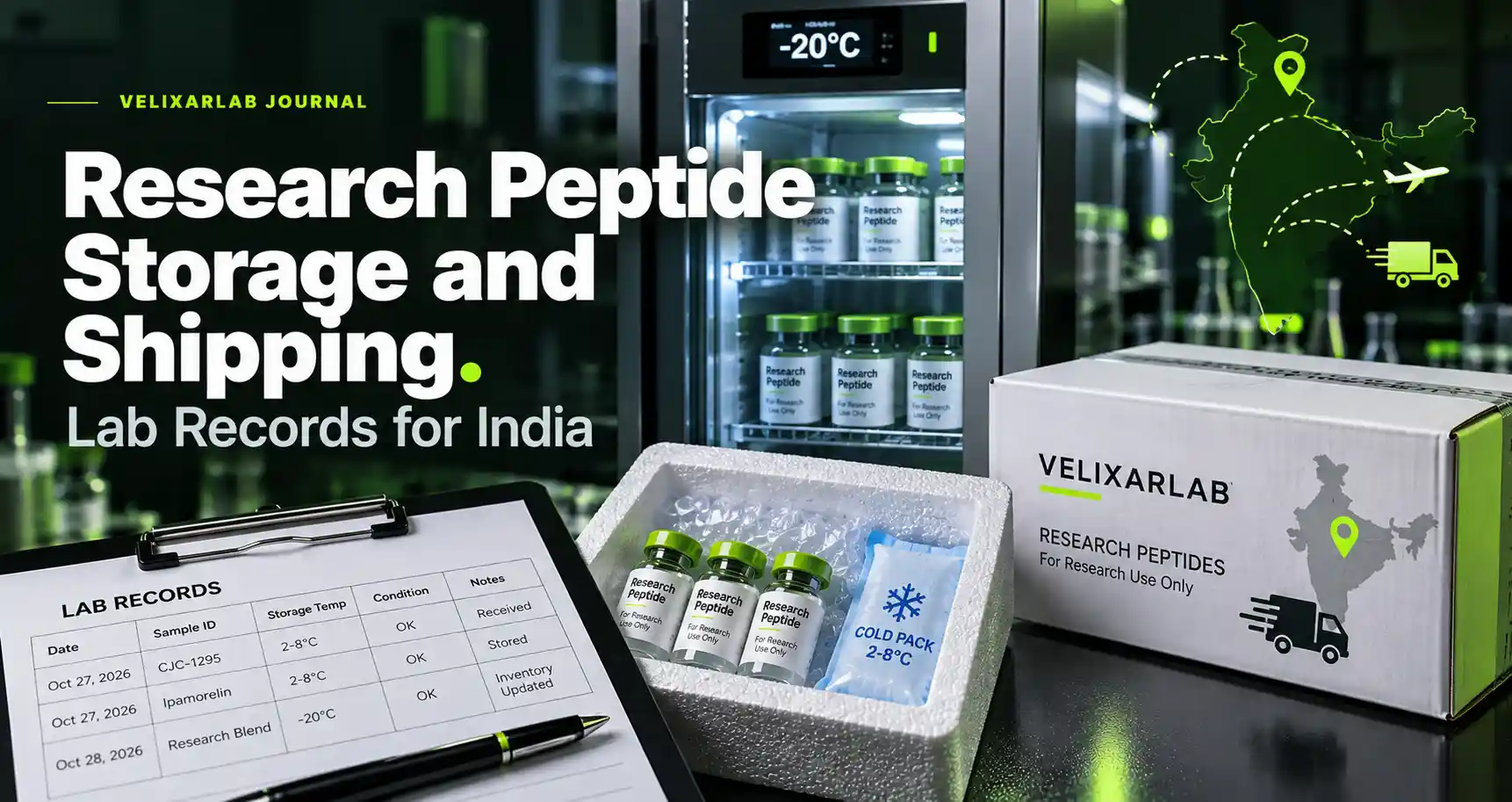
- A cold chain is a defined controlled process, not just an ice pack. Temperature requirements must come from the specific material’s stability data and validated transport conditions.
- Not every lyophilised peptide needs the same temperature. A dry appearance does not prove indefinite room-temperature stability or establish a universal freezing requirement.
- Document the starting condition. Record batch, container, dispatch time, specified range and packaging configuration before shipment.
- Monitor what matters. A calibrated logger or qualified monitoring approach may be necessary when the stability specification demands documented temperature control.
- Assess temperature excursions against evidence. A brief deviation is not automatically safe or unsafe; duration, extremes, material and stability limits all matter.
- Keep a chain of custody. Record transfer points, receiving staff, label identity, seal condition and any discrepancy.
- Indian logistics require route-specific planning. Hot weather, remote deliveries and weekend delays are reasons to assess routes, not grounds for inventing universal shipment guarantees.
Why does peptide cold chain India documentation matter to a research laboratory? A reagent may leave a supplier in acceptable condition yet experience delays, heat exposure, package damage or loss of traceability before reaching the analytical bench. Without defined acceptance limits and relevant shipment records, the receiving institution cannot reliably determine whether its material met the required transport conditions.
For peptide cold chain India planning, the central rule is simple: follow the product-specific stability evidence rather than a universal temperature copied from another peptide listing. The correct process may call for a validated refrigerated, frozen or controlled ambient transport profile, depending on the material and research requirements.
What Does “Cold Chain” Mean for Laboratory Research Samples?
Peptide cold chain India enquiries should distinguish the “shipping condition” from the “storage condition after receipt.” Both may be defined differently in validated product documentation. A laboratory should not copy one temperature field into the other without supporting evidence.
A cold chain is a planned set of storage, handling and transport controls intended to maintain a defined temperature range for materials that require it. The chain may involve prepared packaging, qualified carriers, documented handoffs and temperature monitoring. It is the specified requirement and evidence of control that matter, not the use of the phrase “cold chain” in a shipping advertisement.
For peptide cold chain India, begin by asking whether the material has a substantiated temperature-sensitive specification at all. A controlled ambient range may be adequate for certain defined materials; other items may require refrigeration or colder conditions. A website’s generic storage recommendation cannot replace actual compound- and presentation-specific stability information.
Lyophilised Does Not Mean Chemically Immortal
Lyophilization removes a substantial portion of solvent from a preparation by freeze-drying. Depending on the peptide and matrix, this may improve certain aspects of stability. However, chemical degradation, moisture uptake, aggregation or other changes can still occur. Stability may depend on the container, closure, residual water, light exposure and temperature history.
When preparing peptide cold chain India logistics, keep “lyophilised powder” separate from “validated shelf life” and from “safe at ambient temperature.” These statements require different evidence. Equally, frozen shipment is not automatically better if a material or package has not been qualified for that profile.
Product-Specific Stability Comes Before Packaging Decisions
A practical peptide cold chain India decision log should record the source of the stability specification, its revision date and the material form it covers. This prevents obsolete generic instructions from being applied to a new lot or a different formulation.
The supplier or institution should define applicable storage and transport limits based on suitable data, including the actual chemical form and intended presentation. The range could be described by a temperature band, maximum exposure time, humidity constraints or other relevant conditions.
The contains general scientific principles for stability assessment of biotechnology products and polypeptides. It does not establish shelf life or temperatures for every research reagent sold in India. A laboratory should not apply pharmaceutical registration guidance as if it automatically certifies a supplier.
For peptide cold chain India decisions, ask for the actual stability evidence or approved material-specific handling procedure behind a storage statement. Do not claim a universal “48 hours safe” or “72 hours safe” period without relevant qualification data.
Before Shipment: The Evidence to Check
- Identified material and lot number.
- Product form, vial closure and secondary packaging.
- Applicable temperature and handling specification.
- Permitted transit duration, if verified.
- Packaging or shipper qualification suited to the route and season.
- Agreed logger, indicator or other monitoring system where required.
- Plans for delays, returned shipments and out-of-range exposures.
For peptide cold chain India transport, these records should be clear enough to support an arrival decision without reconstructing the shipment from memory.
Packaging and Monitoring Methods
For peptide cold chain India shipments, the placement of a monitoring device should be justified by the packaging configuration. A logger in an easy-to-access outside pocket may not measure the same environment as the actual vial; the quality record should explain how readings relate to product exposure.
Qualified Insulated Packaging
Insulated containers, phase-change materials, coolants and secondary protective packs may be selected according to the target range and expected journey. Packaging design should consider the outside temperature profile, shipment duration and contact between the product and conditioning materials.
A block of ice inside a box does not prove compliance with a stated temperature requirement. The shipment could still become too warm during a delay or too cold at locations directly against a frozen coolant. Peptide cold chain India qualification should consider both excessive heat and unintended freezing where either is relevant to the material.
Temperature Loggers and Indicators
Temperature loggers provide time-linked records of exposure when correctly selected, calibrated, placed and managed. A simple visual indicator may show that a threshold was exceeded without recording the full time course. The correct monitoring method depends on stability requirements and the shipping process.
The provides useful concepts for temperature mapping in controlled equipment. WHO pharmaceutical distribution guidance discusses temperature exposure records and documentation. Such sources are good-practice references, not evidence that a specific peptide or courier is qualified.
India Logistics: Where Risk Can Enter the Route
Peptide cold chain India route planning should consider whether the receiving laboratory is staffed during the expected arrival window. A carefully packaged shipment left outside an institutional building may experience a different exposure profile from one immediately moved into qualified storage.
India includes diverse regional climates, seasonal heat, humidity, long delivery routes and variations in last-mile service. A shipment travelling between laboratory hubs may face different conditions from one delivered to a remote institution. Even the same destination can have a different temperature exposure profile in different seasons.
For peptide cold chain India, evaluate a defined lane and expected transit duration rather than promising one shipping method is sufficient nationwide. Track the actual courier route, expected receipt hours, institutional delivery procedures and holiday/weekend constraints. The goal is a route-specific plan, not a claim that every package will maintain a universal value for a fixed number of hours.
Chain of Custody and Sample Identity
A *chain of custody* records who handled or received the shipment and how it moved between locations. It is separate from, but complementary to, temperature monitoring. For peptide cold chain India operations, a sample may remain inside a defined range yet have an identity problem if lot labels, package counts or custody records are missing.
Record dispatch and receipt dates, handoff locations as appropriate, recipient authorization, condition of seals and any documented package anomaly. Preserve the supplier’s original lot label and the institution’s receiving identifier together.
A Practical Temperature and Shipment Record Template
The strength of a peptide cold chain India record is that another reviewer can reconstruct the route and decision. If a logger is unavailable, record that limitation honestly and explain what alternate evidence the institution accepts for that material, rather than inventing a temperature trace.
| Field | Example entry | Why it matters |
|---|---|---|
| Material / form | Research peptide X, lyophilised | Defined item and presentation |
| Supplier lot | SAMPLE-IND-26-042 | Sample-to-batch traceability |
| Allowed range | Per approved product specification | Avoids invented universal temperature |
| Dispatch date/time | 20 Oct, 10:00 IST | Starts transit chronology |
| Packaging configuration | Qualified insulated shipper ID | Reproducibility of shipping method |
| Monitoring device | Logger serial and calibration ID | Traceable temperature evidence |
| Transit events | Carrier scan / handoff records | Identifies delays or risk points |
| Arrival date/time | 21 Oct, 15:00 IST | Establishes observed duration |
| Condition on arrival | Seal, vial count and label checked | Supports integrity assessment |
| Excursion review | None / pending / investigated | Records quality decision |
| Receiving reviewer | Authorized person and date | Accountability |
All identifiers here are fictional. A real peptide cold chain India record should use the actual material specification, monitor data and receiving process. It is inappropriate to insert a blanket acceptance temperature in a generic template.
What to Do After a Temperature Excursion
For peptide cold chain India excursion investigations, retain the full time series where available, not just the minimum and maximum. A one-minute spike and a prolonged exposure at the same maximum temperature may carry different risks depending on the product’s stability evidence.
A temperature excursion is an exposure outside the defined accepted range. It is not automatically proof that the material has been damaged, nor can it be dismissed without evidence. The receiving institution should document the duration, maximum and minimum temperatures, monitor placement and any uncertain periods in the record.
For peptide cold chain India, isolate or place affected material on quality hold when required by local procedure. Ask the responsible scientific or quality reviewer to compare the exposure with relevant product-specific stability information. Where the available evidence cannot support continued use, the institution may need additional analysis, return or rejection.
Do Not Guess Based on Package Appearance
A cold-feeling box at arrival does not establish the complete temperature history. Nor does a vial that looks normal prove chemical stability. An intact seal and a clear powder are useful inspection findings but insufficient to resolve an analytical concern caused by an unknown excursion.
The discusses risks across purchasing, handling, repackaging, transport and distribution. The specific legal applicability depends on product classification, but the documentation principles are useful for designing laboratory quality controls.
How to Review VelixarLab India Shipping and Storage Statements
A responsible peptide cold chain India FAQ should avoid blanket commitments that every research vial is transported at 2–8 °C. The right promise is evidence-based: VelixarLab India should state the specific shipping method only when it has validated that method for the relevant product and route.
VelixarLab provides navigation to its handling guidance, while relevant product pages instruct buyers to follow product-specific documentation. The website also displays India-only dispatch on its and listings. These observations do not independently validate a cold-chain process or temperature record.
A qualified buyer assessing peptide cold chain India delivery should ask VelixarLab India which storage and transport specification applies to the exact purchased material, whether the proposed packaging is matched to the journey, and what evidence will accompany a temperature-sensitive consignment.
Research institutions can for product-specific documentation. The article should not promise refrigerated shipment, logger monitoring, defined stability windows, or verified cold-chain compliance unless the supplier can substantiate those claims for the actual service and product.
Common Storage and Shipping Mistakes
- Assuming all lyophilised peptides have the same required temperature.
- Equating “cold pack included” with a fully qualified cold chain.
- Treating a universal transit-duration guarantee as proof of stability.
- Recording arrival temperature while ignoring transit history.
- Discarding original temperature logs or relabelling damaged vials without records.
- Confusing a product COA with a shipment stability report.
- Leaving weekend delays and remote destinations out of the risk assessment.
The purpose of peptide cold chain India documentation is to make each shipment reviewable, not to create additional paperwork without an acceptance decision.
Frequently Asked Questions
Do All Lyophilised Research Peptides Need Refrigerated Shipping?
No universal rule applies. The decision depends on the compound, presentation and relevant stability and packaging data.
Can an Ice Pack Prove a Valid Cold Chain?
No. A pack is a packaging component. The complete process needs to be qualified against the defined shipping specification when such control is required.
Is a Temperature Logger Always Necessary?
Not in every case. The monitoring need depends on product risk and documented requirements. Temperature-sensitive consignments may need suitable recorded evidence.
Does a Brief Temperature Excursion Automatically Ruin the Material?
Not necessarily, but its acceptability must be evaluated using the material-specific stability basis rather than guessed.
What Should an Indian Lab Check at Delivery?
Lot and product identity, container count, tamper condition, shipment records, required monitoring data and any unexplained deviations.
Does a COA Show the Shipment Stayed Within Range?
No. A COA usually documents analytical results for a tested sample. Transit conditions need separate records or evidence appropriate to the agreed shipping process.
Conclusion: Stability Evidence Before Cold-Chain Claims
Good peptide cold chain India practice begins with a defined product requirement, continues through packaging and custody records, and ends with a documented receipt decision. The right controls vary across peptides and shipping routes. Transparent evidence is more useful than generic assurances about summer heat, insulation or ice packs.
For product-specific stability and shipping questions, review and before placing an institutional order.
*Research-use notice: This guide concerns laboratory materials and recordkeeping. It does not establish a shelf life or temperature for any specific compound, and it does not provide human or veterinary administration advice.*
References — scientific and technical sources
- WHO TRS 1025 Annex 7, storage and distribution practices
- WHO temperature mapping tool, monitoring storage equipment
- ICH Q5C, stability concepts for biotechnology / polypeptide products
- WHO technical model guidance for temperature-sensitive distribution records