
TB-500 vs Thymosin Beta-4: Why Sequence Identity Matters
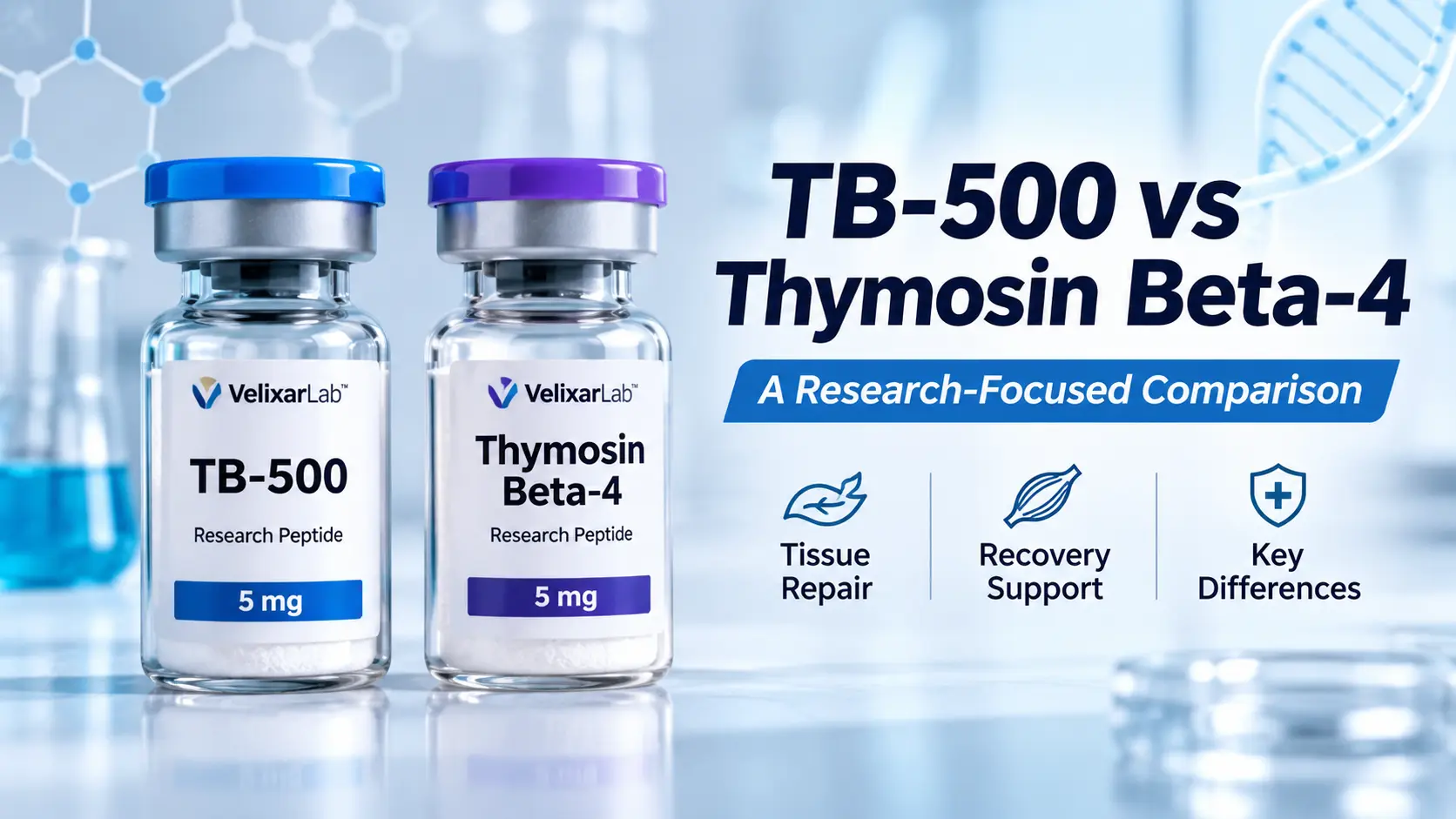
- TB-500 is an ambiguous trade name. A published analytical study identified a material sold under this name as the acetylated seven-residue thymosin beta-4 fragment Ac-LKKTETQ.
- Full-length thymosin beta-4 is different. Mature thymosin beta-4 has 43 amino acids, rather than seven.
- The shorter segment comes from the parent sequence. LKKTETQ represents residues 17–23 of the mature 43-residue chain; database precursor numbering may be shifted by one.
- An acetyl group matters. Ac-LKKTETQ is chemically different from an uncapped LKKTETQ fragment.
- Mass spectrometry helps check the identity. Fragment and full-length species have very different molecular masses, but a real report must be matched to the supplier’s batch.
- Published evidence cannot be transferred by name alone. Findings about full-length thymosin beta-4 are not automatically findings about a seven-residue fragment.
- Check VelixarLab’s lot documentation. Its TB-500 listing does not publicly provide the complete sequence, so the actual supplied form needs confirmation.
A laboratory comparing TB 500 vs thymosin beta 4 is not simply choosing between two spellings. Thymosin beta-4 is a defined, naturally occurring 43-residue peptide associated with actin biology. In the analytical literature, the product name TB-500 has been used for an acetylated seven-residue fragment of the larger peptide. Commercial labels are not used consistently, which makes an exact sequence specification essential.
The priority in TB 500 vs thymosin beta 4 is to identify what molecular species a published paper studied and what a supplier’s vial actually contains. A trade name without sequence, terminal chemistry and an applicable lot-specific report is not sufficient for a reproducible laboratory experiment.
If you are comparing specifications before ordering, see the TB-500 5mg product page for the current India price, batch COA details and stock status.
What Is Full-Length Thymosin Beta-4?
The distinction behind TB 500 vs thymosin beta 4 is also relevant to biological study endpoints. A full-length peptide may present interacting regions and sequence context that a short isolated motif lacks, so the relationship “derived from” is not proof of equivalent function.
Thymosin beta-4 (Tβ4) is a 43-amino-acid peptide found in mammalian cells. It is known in the basic-science literature for interactions with monomeric actin and for involvement in cellular processes studied in a variety of experimental systems. That description does not establish a therapeutic effect for a marketed research vial.
The mature form has a chemically defined sequence and relevant terminal modifications. In the UniProt precursor numbering, an initial methionine may be included before the mature processed chain; this changes the numerical residue labels but not the underlying segment being discussed.
A classic study by examined full-length thymosin beta-4 and fragments in actin-sequestering assays. For TB 500 vs thymosin beta 4, this is a reminder that full length and fragment must remain separate experimental entities.
The LKKTETQ Region
Within mature thymosin beta-4, the sequence LKKTETQ lies at residues 17–23. It is associated with an actin-binding region discussed in the research literature. The presence of those seven letters inside the parent chain does not mean a free fragment and a 43-residue peptide behave identically.
The surrounding residues, three-dimensional interactions, terminal chemistry and the particular assay can influence what is measured. Researchers should not assume a fragment reproduces all the properties of its parent peptide.
What Does the Name TB-500 Actually Identify?
When cataloguing TB 500 vs thymosin beta 4 samples, record the exact observed sequence and terminal modifications. The scientific label TB-500 should be treated as an alias tied to the specified compound rather than as the chemical specification itself.
In 2012, Esposito and colleagues used high-resolution liquid-chromatography mass spectrometry to analyze a material called TB-500. They identified an N-terminally acetylated seven-amino-acid fragment, written Ac-LKKTETQ, corresponding to mature thymosin beta-4 residues 17–23. See the .
This primary report establishes the identity of the material examined in that study; it does not certify the identity of every product currently sold under the TB-500 label. Some suppliers use that label for full-length material or other formulations. For TB 500 vs thymosin beta 4, the exact sample and its analytical records decide which interpretation applies.
Why Terminal Acetylation Is Important
The “Ac-” prefix denotes an acetyl group attached to the fragment’s N-terminus. Adding or omitting that group changes the molecular composition and mass. A sequence string alone may omit this information unless the chemical form is explicitly specified.
When a lab lists “TB-500 fragment,” it should document both the amino-acid order and relevant terminal groups; otherwise the specification may encompass more than one chemical species.
TB 500 vs Thymosin Beta 4: Side-by-Side Identity Table
In TB 500 vs thymosin beta 4 comparisons, make sure the residue-position notation says whether it counts the precursor or the mature chain. Reporting 17–23 without identifying the reference sequence can create avoidable disagreements between otherwise consistent laboratory records.
| Feature | TB-500 as identified in 2012 analysis | Mature thymosin beta-4 |
|---|---|---|
| Chain length | 7 amino acids | 43 amino acids |
| Core sequence | LKKTETQ | Full parent chain containing LKKTETQ |
| Terminal status | N-acetylated fragment | Native mature-chain terminal chemistry |
| Relationship | Fragment corresponding to residues 17–23 | Whole peptide |
| Identity evidence | Exact sequence, terminal modification, suitable mass data | Full sequence, terminal modification, suitable mass data |
| Research transferability | Direct evidence needed for fragment | Parent evidence cannot automatically characterize fragment |
The TB 500 vs thymosin beta 4 table explains an important chemical distinction. Neither column should be treated as describing a VelixarLab batch without supporting lot-specific documentation. Peptide sequences, oxidation or salt forms, and other attributes should be specified on their own basis.
Why Molecular Weight and LC-MS Matter
For TB 500 vs thymosin beta 4 identity assessment, a meaningful analytical report should describe the expected chemical species, the observed molecular-mass evidence and relevant controls. A cropped spectrum or a percentage alone cannot demonstrate whether the vial contains the full chain or an acetylated fragment.
High-resolution mass spectrometry can offer valuable identity evidence because a seven-residue peptide and a 43-residue peptide differ substantially in molecular mass. A laboratory may measure multiply charged ions and calculate the neutral mass, then compare it with the expected molecular form.
In TB 500 vs thymosin beta 4, the expected masses are so different that an appropriately interpreted spectrum can help distinguish full-length peptide from short fragment. However, salt adducts, charge states, impurities and sample preparation must still be taken into account. An observed mass match supports an assignment but does not independently prove every stereochemical detail or all sequence positions.
HPLC Purity Is Not a Sequence Test
A chromatogram with a single dominant peak shows one kind of separation under that method. It does not establish whether the main peak is seven or 43 residues long. A purity percentage also does not establish net content in the vial. For TB 500 vs thymosin beta 4, ask for a method that addresses the identity question rather than relying on a marketing purity value.
is a useful reference for the role of peptide mapping in identification. The exact analytical approach depends on the material and the required decision.
Why Research Findings Do Not Transfer Automatically
The TB 500 vs thymosin beta 4 literature must also be separated by experimental purpose. A doping-control identification study is evidence of a specific detected substance, whereas an actin-binding experiment examines biological interaction. Neither study automatically resolves the other question.
A paper examining full-length Tβ4 may evaluate actin-binding interactions or tissue-related outcomes in an experimental model. A fragment paper may study only a specific sequence region or an analytical identification problem. These are not equivalent questions.
The core principle behind TB 500 vs thymosin beta 4 is that a publication supports conclusions only for the compound, model and endpoint tested. Researchers cannot infer that a seven-residue synthetic fragment has the same effects, safety characteristics or kinetics as the complete parent sequence merely because the fragment comes from it.
Recognize Other Related Peptides
The thymosin family also contains other distinct molecules. Thymosin alpha-1 is not thymosin beta-4. A short N-terminal derivative such as Ac-SDKP is another different molecule, not a synonym for the 17–23 fragment. Carefully recording sequence prevents literature from being mixed between unrelated or partially related compounds.
What Does VelixarLab’s TB-500 Page Confirm?
For a VelixarLab-focused TB 500 vs thymosin beta 4 content strategy, the article should support the product page without silently changing its specifications. Sequence-level identity needs the supplier’s actual batch record; until that is available, both the article and product page should use appropriately limited language.
The currently shows 5 mg, lyophilised form, laboratory research purpose and supplier statements about available batch documentation. It does not publicly list an explicit complete amino-acid sequence or state whether the material is the acetylated 17–23 fragment or a 43-residue preparation.
For TB 500 vs thymosin beta 4, the scientifically responsible action is to request the supplier’s exact sequence, terminal-group designation, chemical form, and lot-specific mass-spectrometry and chromatographic records before making an identity claim. The article should not use an unverified public listing to assert that a particular molecular species is present.
India Laboratory Purchase Checklist
The TB 500 vs thymosin beta 4 acquisition decision can be documented in one line: “Requested compound—full sequence and terminal status—received lot—COA method—identity conclusion—reviewer.” That concise crosswalk is more reliable than storing only a product nickname.
- Obtain the exact sequence and total residue count, not just “TB-500.”
- Confirm terminal acetylation or other specified modifications.
- Match the theoretical formula and mass to the named chemical species.
- Read the actual LC-MS identity report and understand charge-state assignments.
- Review HPLC purity separately from assay content and amount per vial.
- Check the sample ID, lot number, issuing laboratory and report authenticity.
- Confirm storage and transport conditions from material-specific evidence.
- Separate literature evidence from claims about commercial products.
This approach to TB 500 vs thymosin beta 4 supports reproducibility and reduces the risk of purchasing one molecule while citing data obtained with another.
Frequently Asked Questions
Is TB-500 Exactly the Same as Thymosin Beta-4?
Not by name alone. The 2012 analytical literature identified TB-500 as Ac-LKKTETQ, a seven-residue fragment; thymosin beta-4 is a 43-residue peptide. Commercial nomenclature can vary.
What Does LKKTETQ Mean?
It is the one-letter amino-acid sequence for the seven-residue segment found at positions 17–23 of mature thymosin beta-4.
Why Does Ac-LKKTETQ Have a Different Mass From LKKTETQ?
The N-terminal acetyl group adds a chemical modification, changing the molecular formula and mass.
Does a 99% HPLC Result Confirm Which Peptide It Is?
No. It is commonly an area-purity result, not a complete identity measurement.
Can Studies of Full-Length Tβ4 Prove Effects of TB-500 Fragment?
No. Evidence must remain associated with the actual compound and research model investigated.
What Should an Indian Research Lab Ask VelixarLab?
Ask for the exact sequence, terminal modification, applicable lot-specific COA, identity method, actual analytical results and sample-to-vial traceability.
Conclusion: The Sequence Comes Before the Name
The value of the TB 500 vs thymosin beta 4 comparison is straightforward: the same commercial keyword can conceal different chemical species. Full-length thymosin beta-4 has 43 residues; the TB-500 material identified in a key published analysis was an N-acetylated seven-residue segment. That distinction affects mass, analytical identification and how literature should be interpreted.
Researchers can review the and before deciding whether the material fits their laboratory’s needs.
*Research-use notice: This document provides chemical and evidence-literacy guidance only. It does not recommend human or veterinary use of experimental research compounds.*