
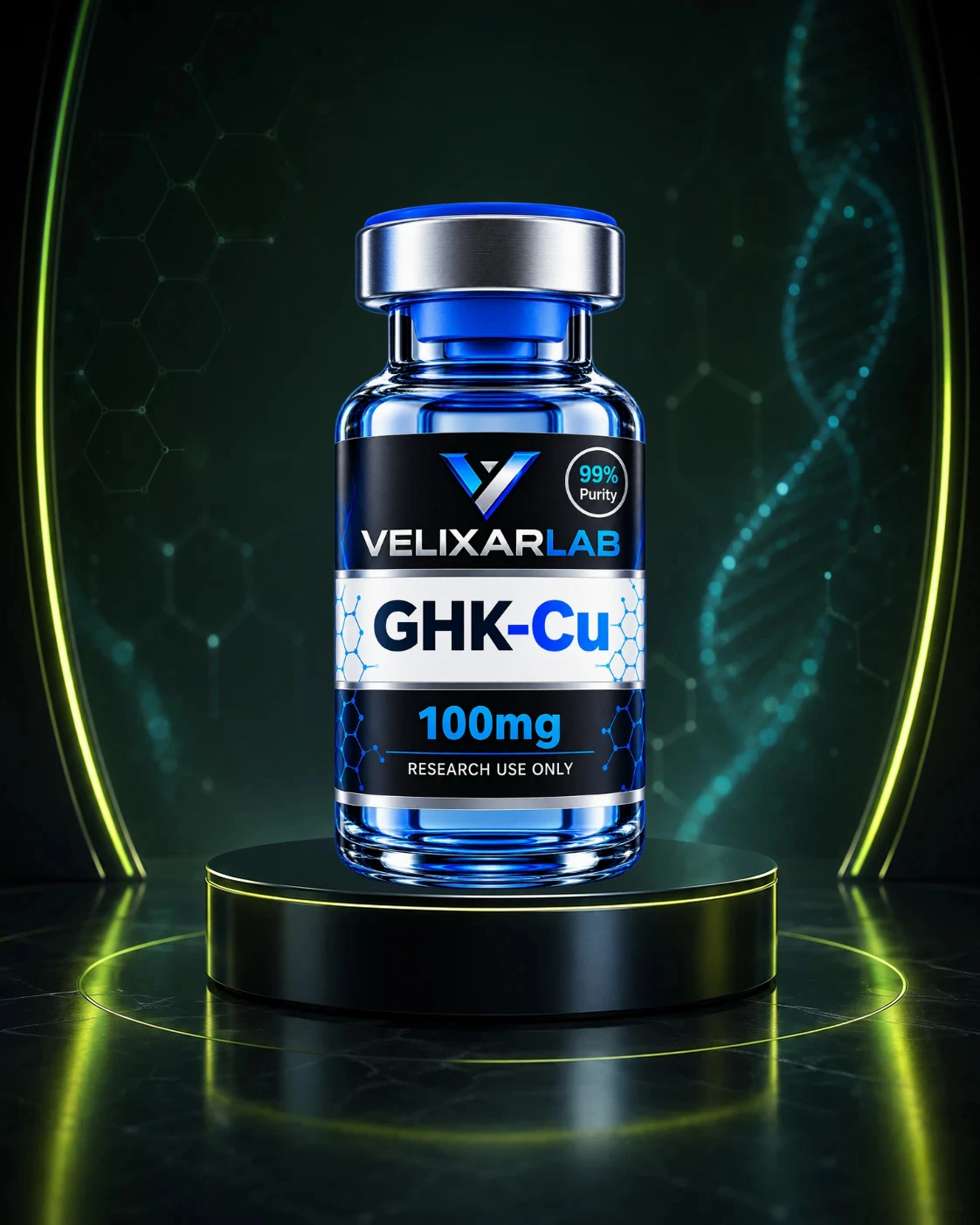
GHK Cu 100mg: Copper Tripeptide for Laboratory Research
GHK Cu, commonly written as GHK-Cu, is a copper(II) coordination complex of the tripeptide glycyl-L-histidyl-L-lysine. The three-residue peptide is abbreviated GHK; adding copper changes the material being studied. For a research laboratory, that distinction matters more than the familiar blue colour or a high purity figure.
VelixarLab’s GHK-Cu 100mg is a lyophilised copper-peptide powder listed for research involving peptide characterisation, copper binding and biochemical assay development. The stated amount is a product declaration, not proof of measured complex content. Researchers should check material identity, the batch-specific certificate of analysis and handling documentation before selecting it for a protocol.
GHK-Cu Product Details
- Product nameGHK-Cu (copper tripeptide complex)
- Declared strength100mg, subject to lot-specific confirmation
- Peptide sequenceGly-His-Lys (GHK)
- Metal componentCopper(II), coordinated to the peptide
- Research formatLyophilised copper-peptide powder
- Critical identity questionGHK-Cu complex versus free (unbound) GHK
- DocumentationLot number, identity, purity, copper and content assays where tested
- RestrictionQualified laboratory research only, not for human or veterinary use
What’s Included
The current listing describes one GHK-Cu 100mg research vial and one complimentary bacteriostatic water vial. Confirm actual package contents at checkout. Included solvent does not establish that a preparation is sterile or suitable for injection.
India Laboratory Procurement
The current listed price is ₹3,000 for the 100mg research vial. Confirm availability, shipping and checkout charges before ordering. If your institution requires a particular analytical standard, request the matching batch documents rather than assuming every report includes the same tests.
GHK, GHK-Cu and Free Copper Are Not Interchangeable
GHK is the tripeptide glycine-histidine-lysine. GHK-Cu describes a coordination complex involving GHK and copper(II). Depending on formulation, pH and other ligands in a sample, copper can be bound, exchanged or present in a more labile form. A measured total copper value is therefore not automatically a measurement of intact GHK-Cu.
This matters when reading a paper or a COA. A method that measures only the peptide, a method that measures total elemental copper and a method that characterises the metal-peptide species answer different questions. If the scientific goal depends on complex formation, look for appropriate evidence of copper association, not just a blue powder and a peptide chromatogram.
What Does GHK-Cu Research Actually Investigate?
Experimental literature has examined GHK-Cu in copper coordination chemistry, biochemical signalling, extracellular matrix processes and laboratory models of cellular responses. Some studies evaluate fibroblasts, gene expression or matrix-related markers. These are experimental endpoints that depend on the specific formulation and model. They should not be converted into claims that a separate research vial can treat a condition or produce cosmetic results in people.
For careful interpretation, chemical speciation, copper coordination, formulation stability and biological evidence need to be considered together. The useful question is not simply what the molecule has been associated with, but which chemical species was present in the experiment?
GHK-Cu Purity Checks: What a Certificate of Analysis Should Show
Peptide quality documents often feature an HPLC percentage. That is useful only when the method, measured species and calculation are clear. For background on what identity checks can demonstrate, read our peptide identity testing guide. For copper peptides, a complete analytical review separates these points:
- Peptide identity: evidence consistent with the Gly-His-Lys sequence and expected mass, using suitable methods such as LC-MS where applicable.
- Copper association: evidence that the reported product is a copper-bound material rather than free GHK mixed with a copper salt.
- Chromatographic purity: the HPLC method, detection conditions and integration basis behind a reported area percentage.
- Measured content: whether the assay quantifies GHK, copper, the complex or total sample mass. A 99% chromatographic area is not a 99mg content result.
- Lot traceability: matching batch ID, testing laboratory, analysis date and a document tied to the supplied material.
- Stability and impurities: specified observations on degradation, free copper or related species, if the laboratory actually tested them.
Not every COA will contain every test. If copper occupancy or net content is not measured, the responsible interpretation is not reported, not automatically passed.
Receiving the Material
Compare the vial identification with the accompanying COA. Record packaging condition, lot number and receipt date in the laboratory inventory. Any discrepancy in identity or quantity should be resolved before experimental use.
Storage and Stability
GHK-Cu stability can depend on pH, light exposure, temperature, buffer chemistry and other ligands. Use storage conditions supported by the specific material and analytical method. Do not assume a universal in-solution shelf life from another brand’s instructions.
Copper Peptide Powder Versus Finished Cosmetic Products
A laboratory copper peptide material is not equivalent to a formulated serum or cream. Finished cosmetic products can contain different concentrations, preservatives, delivery systems and stabilisers. The physical form of a research supply and the data needed for its characterisation are separate from consumer skincare claims.
This page focuses on peptide chemistry, copper coordination, analytical testing and laboratory procurement, not cosmetic application or human administration.
GHK Cu Research FAQs
Is GHK-Cu the same as GHK?
No. GHK is the uncomplexed tripeptide; GHK-Cu refers to its copper coordination complex. The distinction matters for chemical characterisation.
Does a blue colour prove the material is GHK-Cu?
No. Colour alone cannot establish sequence identity, complex formation, purity or copper occupancy.
Does 99% HPLC purity mean a vial contains 99mg of peptide?
No. HPLC peak-area purity and measured material content are different results. Check what was assayed and how the number was calculated.
What should a laboratory check for a 100mg copper peptide powder listing?
Confirm the stated amount, molecular identity, copper association, COA batch number, quantitative method and material-specific handling requirements.
Can the material be assumed suitable for injection or cosmetic use?
No. This is laboratory research material, not a finished medicine or consumer cosmetic formulation.
How can researchers request analytical records?
Contact VelixarLab with the required lot number and methods. Ask whether copper content, peptide identity, chromatographic purity and net complex content were measured.
Research Use Only
This listing is intended for lawful scientific and analytical research by qualified laboratories. It is not for human or veterinary treatment, injection, consumption or cosmetic application. A research-use label does not substitute for batch-specific verification or applicable legal requirements.
Reviews
There are no reviews yet.