
Peptide Solvent Compatibility: What Research Datasheets Must State
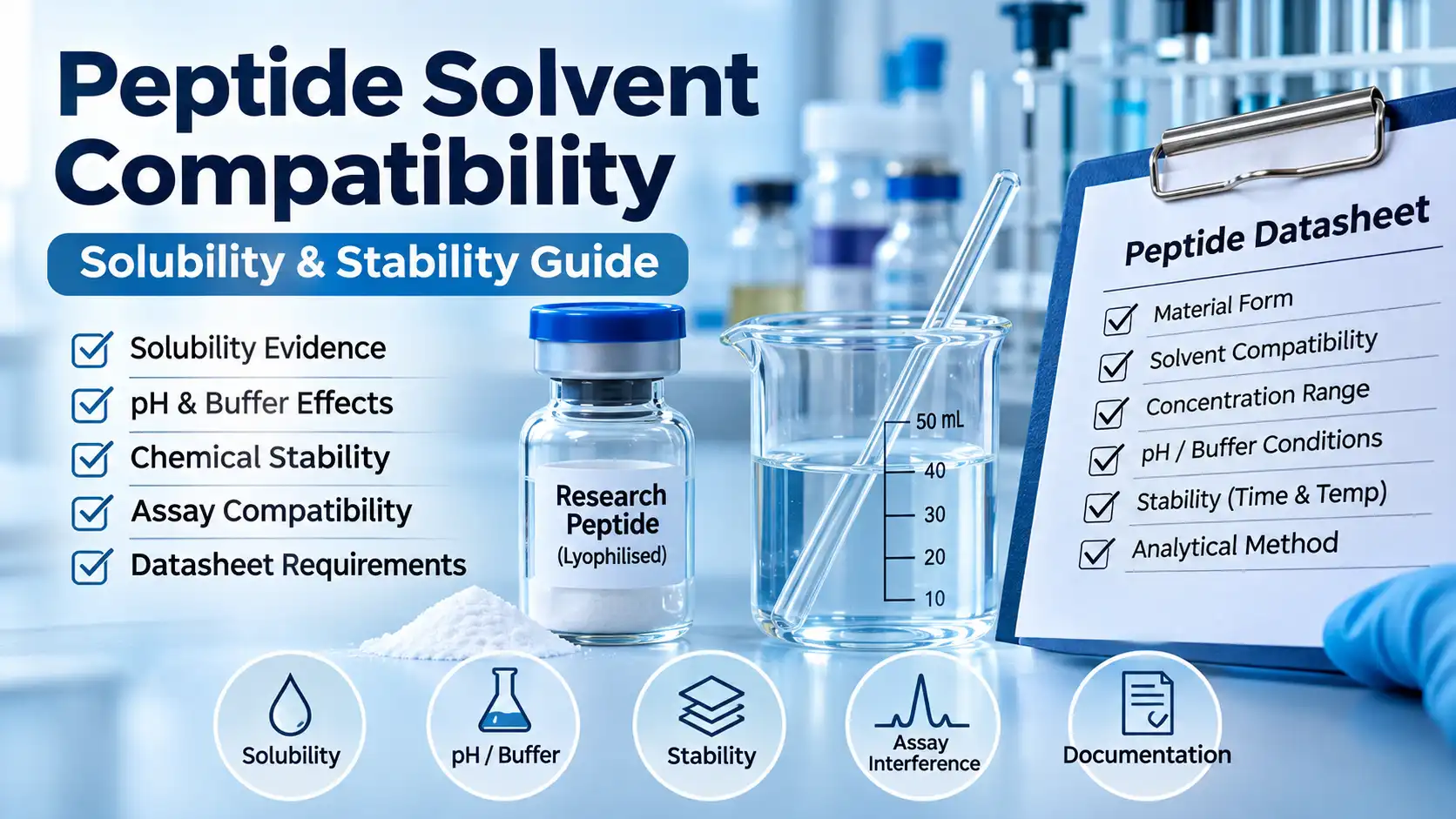
- No universal solvent works for every peptide; the exact molecule and chemical form control compatibility.
- Datasheets should name the purpose and evidence for any solubility or stability claim.
- pH, buffer composition, ionic strength and sample concentration can change solubility and aggregation.
- Dissolution, chemical stability, assay compatibility and biological suitability are separate questions.
- A clear-looking sample may still have undergone degradation or contain undetected aggregates.
- Laboratory records should connect each prepared sample to a parent lot, method, operator and date.
- Use institution-approved protocols and compound-specific evidence; this article does not provide administration or injection instructions.
A researcher receives a lyophilised peptide with a datasheet that says “dissolve before use” but provides no relevant solvent, concentration range or stability evidence. That statement is not enough for a reproducible experiment. Peptide solvent compatibility research begins with the exact molecular identity and the intended analytical purpose—not a universal recipe.
This guide explains what a supplier or laboratory datasheet should actually state: material form, evidence of solubility, solvent and buffer compatibility, pH sensitivity, permitted concentration range, sample handling limits and relevant analytical methods. It is a documentation guide for laboratory research, not a preparation procedure for administration.
Why Peptide Solvent Compatibility Research Is Molecule-Specific
Peptide solubility depends on sequence, modifications, charge state, terminal groups, counterions and the surrounding medium. A peptide rich in hydrophobic residues can behave differently from one with many charged residues. The same material can also respond differently at different concentrations or ionic strengths. Thus peptide solvent compatibility research cannot be replaced by a generic statement such as “all peptides dissolve in water.”
Merck’s Solubility Guidelines for Peptides emphasize choosing a solvent that dissolves the material, fits the experiment and does not promote unwanted reactions or degradation. These conditions are logically distinct. A substance can dissolve while becoming unsuitable for a particular downstream measurement.
Peptide Solvent Compatibility Research: Datasheet Requirements
Precise compound identity and supplied form
A technical sheet should name the peptide sequence where appropriate, relevant chemical modifications, salt or counterion form, lyophilised or solution presentation and nominal or assayed quantity basis. Differences in chemical form can alter sample behaviour; a catalog name alone is insufficient. Our research peptide datasheet guide explains how to interpret those specification fields.
Solubility evidence and reporting conditions
An evidence-based claim should state whether compatibility was measured, inferred or taken from published literature. Specify the tested solvent or buffer, relevant concentration range, method and sample conditions where support exists. Do not convert one observed condition into a universal rule for every laboratory application.
pH, buffer and ionic-strength effects
Changes in pH may alter peptide protonation, electrostatic interactions or chemical stability. Buffer components and ionic strength can affect aggregation, adsorption and interactions with analytical systems. A datasheet should identify known limitations and link them to the method or stability information that supports them.
Solubility Is Not Stability
A sample may appear completely dissolved but contain altered peptide species, degradation products or aggregates below visual detection. Conversely, a temporarily cloudy sample need not establish chemical degradation. Distinguish visual solubility, molecular identity, chromatographic purity and stability under the actual conditions of use. Read what peptide identity tests can and cannot verify to understand those analytical limits.
Physical versus chemical changes
Physical issues may include aggregation, precipitation or adsorption to container surfaces. Chemical changes may include hydrolysis, oxidation or other sequence-dependent transformations. The analytical consequences differ, so observations should be interpreted with suitable controls rather than guessed from appearance.
Time and temperature limitations
The relevant stability window depends on formulation, solvent, container, analyte, temperature and the research method. Published stability findings from one preparation cannot automatically establish another. For peptide solvent compatibility research, ask whether the quoted stability period applies to the dry material or a prepared solution and whether it is supported by actual measurements. Our research peptide storage and shipping guide provides related handling and records context.
Solvent Compatibility Versus Assay Compatibility
A solvent may dissolve an analyte while interfering with a detector, enzyme, cell model or chromatographic separation. In a quantitative assay, the solvent system should be compatible with standards, extraction, calibration and recovery. Record matrix effects, chemical reactivity and instrument restrictions when relevant.
Under the , method suitability depends on the intended analytical purpose. The guidance is written for regulated pharmaceutical analysis, but its distinction between identity, purity, impurities and assay helps laboratories ask precise questions about research-compound testing.
| Datasheet field | What should be reported | Why it matters |
|---|---|---|
| Chemical form | Sequence/modifications/counterion | Determines chemical identity |
| Solubility basis | Tested method and conditions | Shows evidence behind claim |
| pH/buffer | Known compatibility limits | Controls matrix and chemical effects |
| Stability | Conditions and observation interval | Avoids assumed shelf life |
| Container | Material compatibility where relevant | Limits adsorption/extractables risk |
| Quantification | Method and actual reporting basis | Prevents purity/content confusion |
| Lot | Sample and COA relationship | Supports traceability |
Documentation for Laboratory Sample Preparation
A controlled research record can include parent vial and lot, aliquot identifier, approved procedure reference, recorded solvent or buffer identity, preparation date, operator, storage location and planned analytical assessment. It should distinguish measured concentration from a value calculated using a nominal amount. These are recordkeeping fields rather than operational mixing directions. For traceability examples, consult the peptide sample labeling and laboratory records guide.
Contamination prevention and container compatibility
Laboratories should follow their institutional contamination-control procedures, manage clean equipment and use containers validated or judged appropriate for the actual material. Do not assume any one reagent is sterile, compatible with all plastics, or appropriate for every downstream test. Sterility and endotoxin are separate test claims.
What to document after a deviation
If the wrong medium was recorded, the sample unexpectedly changed appearance or a required environmental condition was exceeded, preserve the original record and follow local hold-and-review procedures. Documentation does not by itself determine chemical acceptability; suitable evidence or fresh analysis may be needed.
How VelixarLab Should Support Material-Specific Enquiries
The introduces peptide handling topics, and the identifies marketed research materials. Those pages are starting points only. For peptide solvent compatibility research involving a particular lot, a lab should request actual supplier specifications and applicable stability evidence through .
For example, the is a copper-associated peptide system. Metal coordination can make method-specific chemistry especially relevant; a generic peptide recipe would not establish that the intended complex remains unchanged under an experimental condition. This is an analytical consideration, not a claimed defect in VelixarLab stock.
What Counts as Good Compatibility Evidence?
A statement is stronger when it identifies the exact peptide chemical form, the medium tested, the analytical observations and the relevant time or concentration window. A method report showing chemical stability under one specified condition is narrower than a generic claim that a material is “stable in solution.” Our peptide COA red flags guide outlines common documentation gaps to review. For peptide solvent compatibility research, the datasheet should state the difference between a supplier-tested claim, a literature observation and a recommendation still requiring local validation.
Peer-reviewed evidence can help explain expected solubility behaviour, but published experiments may use alternative salt forms, matrices or detection methods. A laboratory should not silently transfer a reported condition from one formulation to another. When the underlying study is unavailable, describe the information as supplier guidance rather than laboratory-confirmed compatibility.
Analytical Interference Should Be Explicit
Certain media can produce background signals, alter chromatographic peak shape, affect pH-dependent retention or disrupt the downstream assay. A compatible sample medium must therefore meet two tests: the material behaves acceptably and the scientific method still measures what it was designed to measure. In peptide solvent compatibility research, a warning about known assay interference is just as valuable as a positive solubility statement.
Documentation can identify whether an observation used chromatographic purity, mass-related identity, visual precipitation, particle measurement or another endpoint. Those measurements should not be treated as interchangeable. An assay may detect degradation even when no visible cloudiness occurs; conversely, a transient visual change does not establish the chemical nature of a sample. Learn how mass-related data supports identification in our peptide mass spectrometry guide.
Peptide Solvent Compatibility Research: Questions for Suppliers
A research team can ask: Which exact compound form was evaluated? What solvent and pH conditions have documented evidence? Which method was used to examine stability or solubility? Are there known incompatibilities with buffers, plastic surfaces or analytical detectors? What information is unavailable for this batch? Keeping these questions together makes peptide solvent compatibility research reproducible without turning a general blog into unverified laboratory preparation instructions.
Frequently Asked Questions
Is there a universal solvent for research peptides?
No. Solubility and compatibility depend on exact sequence, chemical form, concentration and intended method.
Can a clear solution still contain degraded peptide?
Yes. Clarity is not proof of identity, absence of degradation or adequate analytical purity.
Why does buffer pH matter?
It may alter charge state, chemical stability, aggregation and method compatibility; effects are material-specific.
Does a lyophilised label establish solution stability?
No. Dry-state presentation and solution stability are different attributes requiring evidence.
Should a datasheet list one preparation recipe for every peptide?
No. It should document product-specific validated or appropriately supported compatibility and refer researchers to approved laboratory procedures.
Is solvent compatibility evidence the same as sterility?
No. Chemical compatibility, sterility, and endotoxin status are separate concerns with different evidence needs.
The central goal of peptide solvent compatibility research is a defensible record of which compound and analytical purpose were evaluated under which chemical conditions.
Good peptide solvent compatibility research also names what has not been tested; otherwise a datasheet can accidentally imply broader chemical stability than the evidence supports.
In peptide solvent compatibility research, requests for original stability or solubility studies are often more informative than general handling statements.
A complete peptide solvent compatibility research brief explains whether each compatibility statement is a verified laboratory measurement or an untested expectation.
For peptide solvent compatibility research, the downstream assay and detection technology are part of the context in which a medium is considered suitable.
A peptide solvent compatibility research record should identify the tested chemical form and its limits instead of presenting one formulation as a universal standard.
Conclusion
Peptide solvent compatibility research should yield a defensible laboratory datasheet: exact identity, tested solubility conditions, meaningful limitations, method fit and traceable sample records. Avoid universal assumptions and request material-specific documentation before relying on a preparation in a study. to enquire about applicable product information.
Technical Sources and Reading
- Merck: Solubility Guidelines for Peptides
- ICH Q2(R2) analytical validation
- WHO Laboratory Quality Management System handbook
Research-use notice: This is educational laboratory documentation content, not medical advice or instructions for human or animal use. Regulatory guidance cited for analytical best practice does not certify a specific supplier or imply every research reagent is governed by the same pharmaceutical standard.