
Peptide Research Glossary: 35 Essential Laboratory Terms
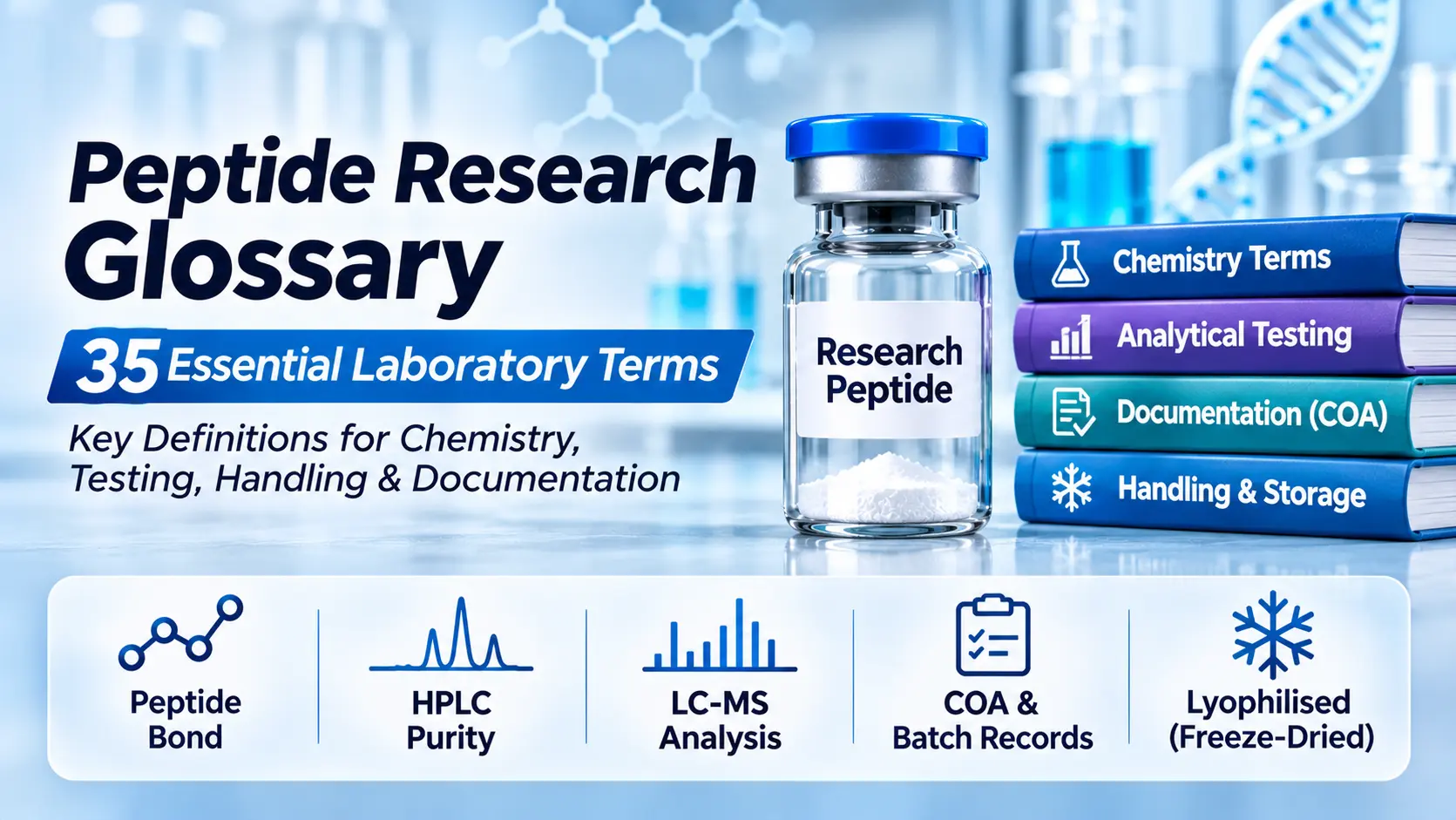
- This peptide research glossary explains chemistry, analytical testing, material handling and documentation terms without treating laboratory products as medicines.
- Peptide bonds connect amino-acid residues; the sequence and chemical modifications determine a molecule’s identity.
- HPLC purity, an identity test and an assayed amount are three different measurements.
- LC-MS supplies mass-related analytical evidence, but an intact-mass match cannot confirm every structural detail.
- Lyophilised means freeze-dried; neither appearance nor the label automatically proves stability or vial content.
- A COA should be connected to the actual lot and should identify what tests were performed.
- India-based laboratories should use the correct definitions in purchasing, inventory and quality records and follow institutional requirements.
Introduction: Why the Right Laboratory Vocabulary Matters
A product datasheet might describe a lyophilised research peptide, 98.5% HPLC area purity, mass-spectrometry identity and a batch-specific COA. These phrases are familiar to an analytical chemist but can lead to costly misunderstandings when a procurement officer reads them as guarantees of content, identity and safety. This peptide research glossary supplies plain-English definitions that still retain the scientific limits of each term.
The 35 entries are organized by task: chemical identity, analytical results, batch documentation, and day-to-day records. Use the peptide research glossary as a reference when comparing supplier paperwork; it is not a substitute for a validated test method or an approved laboratory protocol. The examples are educational and do not describe a tested VelixarLab batch.
This peptide research glossary separates the meaning of an analytical term from the quality claim a supplier may attach to it. For practical examples, see our research peptide datasheet guide.
A. Peptide Chemistry and Material Identity — Terms 1–9
Understanding molecules, not marketing labels
1. Amino acid. An organic molecule with amino and carboxyl functionality; amino-acid residues are the building blocks of ordinary peptides. Side chains differ and influence charge, solubility and interactions. Not every research compound sold alongside peptides is an amino acid chain.
2. Peptide bond. An amide linkage connecting two amino-acid residues in a peptide’s backbone. A bond identifies the general molecular class, not the exact sequence or activity of a particular product.
3. Peptide sequence. The specified order of residues, customarily written from the N-terminus to C-terminus. A sequence claim requires supporting analytical evidence; a matching molecular mass alone may not distinguish some sequence isomers.
4. N-terminus. The amino-terminal end of a peptide chain. Terminal chemical modifications can change the chemical identity and need to be recorded in specifications.
5. C-terminus. The carboxyl-terminal end of the chain. A free acid and an amidated terminus are not automatically interchangeable materials.
6. Synthetic peptide. A peptide created through controlled chemical synthesis or an appropriate synthetic process. Synthesis does not by itself prove a commercial sample meets its intended quality specification.
7. Peptide analogue. A molecule related to a reference peptide but deliberately changed through sequence substitution, terminal modification, or another structural change. Evidence for the parent compound may not apply to its analogue.
8. Counterion. An ion associated with a charged peptide or salt form, such as acetate in some preparations. Counterions may affect gross mass and analytical comparisons; they require the relevant method to quantify them.
9. Molecular formula. The count of atoms in a defined chemical species. When reading a peptide research glossary, remember that a specified hydrate, salt, or copper complex may have a different formula from the free peptide.
B. Analytical Testing — Terms 10–19
Purity is not identity or content
10. HPLC. High-performance liquid chromatography separates sample components using a mobile and stationary phase. Detector type, method conditions and sample preparation determine what a reported result means.
11. Chromatogram. A plot of a detector’s response over time or another separation dimension. Peaks reflect detected eluting components; a visually single peak can conceal co-eluting species.
12. Retention time. The time a detected component takes to emerge from a chromatography system under defined conditions. A match with a reference helps identification but is not complete structure proof.
13. Peak area. The integrated detector response associated with a chromatographic peak. It is not necessarily proportional to material mass across chemically different components without appropriate calibration.
14. HPLC area percent. The area of an assigned peak relative to the sum of included peak areas. A report of 99% area cannot alone establish 99% peptide by weight.
15. Co-elution. Two or more compounds emerging together so a method cannot adequately distinguish their signals. A dominant peak can therefore be less chemically specific than its appearance suggests.
16. Mass spectrometry (MS). Instrumental measurement of ions by mass-to-charge ratio. It supplies mass-related evidence and, in suitable forms, additional structural information.
17. LC-MS. Liquid chromatography connected to a mass spectrometer. It can associate chromatographic components with mass-related signals when the method is suitable; it is not inherently a universal purity assay. Learn more in our peptide mass spectrometry and identity guide.
18. Molecular identity. Evidence supporting the claim that the sample contains a particular chemical entity. An intact-mass match may be informative without resolving isomers or stereochemistry. Read what peptide identity tests can and cannot verify for the limitations of different methods.
19. Assay. A defined procedure measuring a specified characteristic, often content or concentration. A quantitative assay needs appropriate standards, calibration, units and validation for its purpose.
This peptide research glossary deliberately separates words that supplier marketing sometimes merges. The discusses procedures designed for identification, impurities and assay; those are related but distinct analytical objectives.
A peptide research glossary can explain a chemical description, but a verified sequence still requires actual analytical evidence.
C. Quality Documentation — Terms 20–27
Following the evidence through a lot
20. Certificate of Analysis (COA). A report of actual results for an identified material sample or batch, usually with methods and acceptance criteria. A certificate is meaningful only if it can be linked to the material under review.
21. Specification. A documented criterion a product or test is intended to meet. A specification is a target or acceptance limit, not the measured result for the supplied lot.
22. Batch. A defined quantity managed under a production or packaging system. Suppliers must explain how source batches map to finished containers.
23. Lot number. An identifier assigned to such a quantity. Multiple laboratory accession or packaging numbers may be valid if records connect them.
24. Batch traceability. The ability to link a vial and local inventory entry back through the supplier lot, submitted sample and applicable laboratory report. See our peptide sample labeling and laboratory records guide for traceability context.
25. Analytical method. A documented test procedure specifying how a characteristic is measured. Method suitability depends on sample type, selectivity, accuracy and the intended decision.
26. Limit of quantitation (LOQ). The lowest amount an analytical procedure can quantify with acceptable performance under its demonstrated conditions. A signal below the LOQ should not be reported as a precise amount without justification.
27. Independent testing. Analysis conducted by an organization independent of the supplier. Independence is useful but does not replace issuer authentication, sample traceability, or method review.
For Indian institutions using this peptide research glossary in procurement, distinguish accreditation for named tests from a generic accreditation badge. For additional checks, review our peptide COA red flags guide. Accreditation alone cannot validate an unrelated COA.
In research training, a peptide research glossary is most useful when each definition is matched to a real document field.
Keep this peptide research glossary available when comparing laboratory methods that use similar words for different measurements.
D. Laboratory Handling and Research Design — Terms 28–35
Terms used after receiving material
28. Lyophilised. Freeze-dried. Lyophilization removes much water, but remaining moisture, stability and final content must not be assumed from appearance.
29. Reconstitution. Bringing a dry laboratory material into a defined solution under an approved, material-specific protocol. No universal solvent or preparation procedure suits every peptide.
30. Solubility. The capacity of a specified substance to dissolve under defined conditions. It can depend on concentration, solvent, pH, counterion form and temperature.
31. Stability. Evidence that a material retains defined characteristics over time under specified conditions. A label saying “freeze-dried” is not a complete stability study.
32. Chain of custody. Documented transfer and control of an identifiable sample between people or facilities. It supports traceability but does not alone prove chemical identity.
33. In vitro. Studies outside an intact living organism, including cell cultures and biochemical systems. Such results do not by themselves establish outcomes in people.
34. Preclinical. Research conducted before or outside human clinical evaluation, including in-vitro and animal models. The term describes a research context, not a stamp of regulatory approval.
35. Research use only (RUO). A statement of intended laboratory use. It is not proof of identity, purity, sterility or an exemption from all applicable legal obligations.
How to Apply This Peptide Research Glossary to a Real Datasheet
Imagine a fictional document that states: “Synthetic peptide X; lyophilised; 99.0% HPLC area; identity consistent by LC-MS; lot SAMPLE-26-042.” The responsible interpretation is limited: the report claims a synthetic material, a freeze-dried presentation, a particular chromatographic-area result and identity evidence for the named lot. It does not say that the powder is 99% peptide by total weight or that all biological or microbiological attributes were checked.
Use this peptide research glossary to identify the three follow-up questions: Which original analytical method generated the value? Can the lot be connected to the vial received? Is an assay or additional test needed for the specific project? The right questions are more valuable than guessing a conclusion from a technical abbreviation.
A peptide research glossary should reinforce that laboratory identity evidence is not evidence of any approved therapeutic use.
For procurement staff, the peptide research glossary helps distinguish batch-level test results from general catalogue specifications.
This peptide research glossary treats handling terminology as material-specific rather than assuming every freeze-dried sample is identical. For further context, review research peptide storage and shipping guidance.
For contextual product information, explore the or the . Product descriptions are an entry point to a documentation enquiry, not independently authenticated testing evidence.
Use the peptide research glossary to record what was not tested as clearly as what the certificate reports.
FAQs About Peptide Research Terminology
Does HPLC purity confirm a peptide’s whole sequence?
Not by itself. A chromatographic result concerns separation and detector response. Suitable mass spectrometry, fragmentation, reference comparison or other structure-sensitive methods may be required for the intended identity claim.
Is a COA the same as a product datasheet?
No. A datasheet describes expected chemical properties, handling and specifications; a COA reports measurements for an identified sample or batch. Both can be useful and neither replaces the other.
Does 99% purity mean the vial contains 99% of its labeled amount?
No. A relative chromatographic peak-area percentage cannot independently establish net peptide mass or filling accuracy. Quantity needs an appropriate measurement on the declared basis.
Is NAD+ a peptide?
No. NAD+ is a dinucleotide coenzyme. It may appear alongside research peptides in a shop catalogue, but it should be chemically classified separately.
Is a laboratory’s NABL badge sufficient to verify any test report?
No. Check the laboratory’s current accreditation and the particular tests covered by its accredited scope, and authenticate the document where necessary.
Conclusion: Use Terms Consistently Across Lab Records
This peptide research glossary is designed to make scientific paperwork easier to compare without losing precision. Separate chemical identity from analytical purity and quantity; connect every report to the right lot; document handling according to appropriate local protocols. When you need a specific material’s available specifications, .
Research-use notice: Educational laboratory terminology only. Research compounds are not intended for human or animal consumption; a glossary, label or COA is not evidence of medical safety, effectiveness or authorization.