
How to Spot an Unverifiable Peptide COA Red Flags
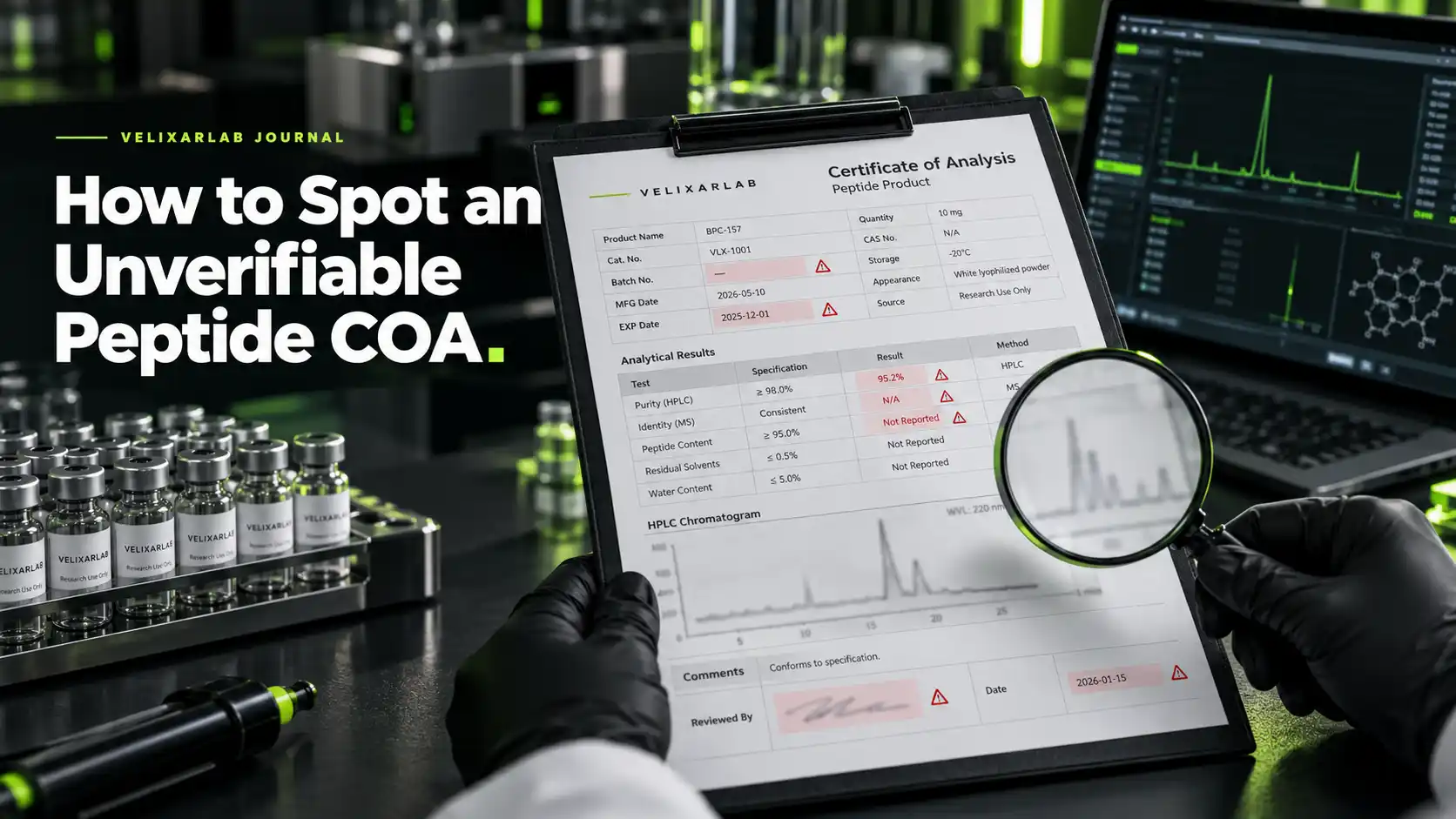
- An unverifiable COA is a documentation problem—not automatic proof that a product is fraudulent or chemically defective.
- A lot mismatch is a high-priority exception unless a controlled bulk-to-packaging mapping explains it.
- A named laboratory and report identifier allow independent verification; a logo alone does not.
- An HPLC purity percentage without method, units or sample reference has limited value.
- Old dates require context: a report is not invalid just because it predates the latest shipment.
- Edited screenshots, unexplained corrections or a reused generic PDF call for clarification and original records.
- Use a written hold, verify, resolve or reject workflow rather than silently accepting uncertain evidence.
A peptide certificate can be polished, detailed and still unhelpful for the vial being purchased. The phrase peptide COA red flags describes gaps and inconsistencies in the document trail, not proof of intentional deception. A useful quality review asks which claim cannot be checked and what evidence could resolve it.
Start with the report’s link to the material. Confirm the batch, the testing laboratory and the test scope before judging the purity value. The objective is a traceable conclusion, not a verdict based on how professional a PDF looks.
Peptide COA Red Flags: What Makes a Report Verifiable?
A Certificate of Analysis should identify the tested material or sample, the lot or accession number, issuing laboratory, analytical date, test method, reported results and any applicable acceptance criteria. Where relevant, it should have an authenticating report number and authorized issue information. The exact layout can vary by lab; there is no single decorative template that guarantees validity.
The gives a detailed pharmaceutical documentation benchmark covering batch identification, analytical results and issuer information. It does not mean every research material follows pharmaceutical GMP, but it helps explain why test context matters.
Nine Peptide COA Red Flags Worth Checking
1. Mismatched lot or sample identifier
Compare vial, packaging, packing list, COA and lab report. A mismatch may reflect repackaging or a laboratory accession code rather than misrepresentation. Request an auditable crosswalk before assuming equivalence. If none exists, the report cannot reliably be assigned to the delivered lot.
2. No identifiable issuing laboratory
A vendor phrase such as “independently tested” cannot be verified without a named testing provider and a report reference. Ask who performed the work, whether it was in-house or independent, and how the issued record can be checked.
3. Test result without a named method
“99% pure” does not specify whether the result is chromatographic area percentage, assay by weight or a different metric. A defensible result identifies the measurement, method, units, and acceptance criterion. Peptide COA red flags often originate from unsupported interpretation rather than a numerically suspicious value.
4. Old test date with unclear batch history
A report can legitimately predate distribution. The problem is an unexplained mismatch between the manufacturing lot, testing date, retest or stability requirement and shipped sample. Do not call a report fake solely because it is old; request the batch chronology and applicable stability evidence.
5. Reused generic COA for different lots
One certificate may appropriately cover multiple containers from the same defined batch. It cannot automatically be applied to distinct manufacturing lots. Compare the identifiers and ask how lots are assigned, divided or relabeled.
6. Purity presented as content or sterility
Chromatographic purity is not net peptide quantity. Likewise, chemical identity or HPLC purity does not establish sterility or endotoxin status. These claims require suitable tests and results. A certificate missing one attribute is not necessarily false; it simply cannot substantiate that attribute.
7. A scan or screenshot that cannot be authenticated
A flat image may be a legitimate copy but can remove useful report context. Ask for the original issuer-controlled report, verification identifier or a confirmation through the laboratory’s independently located contact channel. Digital signatures and QR codes must be checked at their genuine destination.
8. Unexplained revisions and inconsistent values
Corrected documents are possible and can be legitimate. Look for revision identifiers, a clear reason for correction, date and superseded record. If the same report number appears with conflicting results and no revision trail, place the documentation on hold.
9. Accreditation claims outside the stated scope
A laboratory may hold an accreditation that covers some but not all its tests. Use the to locate its certificate and examine the detailed analytical scope. Accreditation does not automatically authenticate a specific sample result. This is among the most actionable peptide COA red flags for India institutional reviews.
Peptide COA Red Flags: Missing vs Inconsistent Evidence
| Finding | Example | Appropriate next action |
|---|---|---|
| Missing | No net-content assay | Document limitation; ask if required |
| Inconsistent | Lot code differs | Request controlled mapping |
| Unverifiable | Unnamed testing laboratory | Request issuer and report verification |
| Contradicted | Issuer confirms report number is not genuine | Escalate with retained evidence |
Do not label a supplier fraudulent based solely on a missing chromatogram or a date discrepancy. Conversely, a professional-looking certificate does not overcome an issuer denial or an unresolved material-to-report mismatch. Good quality practice records the evidence and the limitations of each conclusion.
How Indian Laboratories Can Verify a Suspect COA
- Capture the original report and physical label before requesting a corrected file.
- Check compound name, form and sample or lot identifier against the purchase record.
- Identify the issuing testing laboratory from an independently verified source.
- Request the specific laboratory report number and authorized document version.
- Check which tests were actually performed and whether units and acceptance limits are stated.
- Verify claimed NABL accreditation and relevant testing scope if it matters to the project.
- Record the supplier explanation and decide whether to accept, hold, retest or reject.
The most useful peptide COA red flags workflow retains the original, the supplier response and the resolution in one record. This enables a later researcher to see not only which result was accepted but why.
A Fictional Example: Real Report, Wrong Lot
A received vial shows lot PK-027, while a supplied COA names BULK-014. The laboratory report is genuine for a sample coded LAB-827. The supplier offers an internal log connecting PK-027 to BULK-014 and the test submission to LAB-827. If the chain is authentic and otherwise adequate, the differing codes could be reconciled. Without the log, applicability remains unverified. This example is fictional and does not describe any specific VelixarLab India batch.
What to Ask VelixarLab India About Available Reports
VelixarLab provides product information in its . If a purchaser needs batch-specific evidence, they can with the item and lot information and request the original relevant analytical details. The purpose is to verify actual documents, not to assume a product listing proves every listed claim.
For laboratories investigating peptide COA red flags, applying the same scrutiny to all suppliers, including VelixarLab India is the credible approach. Avoid publishing broad accusations or statements about authenticated testing without original evidence.
A Document Integrity Check Without Assuming Forgery
A quality reviewer may notice inconsistent fonts, cropped signatures, an oddly placed logo or a screenshot instead of a PDF. These can prompt a request for an original report, but they are not conclusive evidence of manipulation. Laboratories use different reporting software and sometimes issue scanned records. The peptide COA red flags process should focus on authenticating the report against the issuer’s own records rather than relying on visual guesswork alone.
If a report has been revised, request the authorized corrected version and ask whether earlier copies were withdrawn. Record report number, revision date and the explanation for change. If the document carries an electronic signature or verification link, confirm that the issuer controls the verification channel. A file hosted on the seller’s site may be a genuine copy, but its presence alone does not validate authorship.
Escalating a Suspected Certificate Problem
Where peptide COA red flags remain unresolved, an institution can quarantine the material, preserve the package and documents, and ask the supplier for a written response. If needed, qualified independent analysis may answer chemical questions, but it does not automatically establish the history of the supplied lot. Report authenticity and chemical composition are related yet separate investigations. The laboratory’s quality lead should determine any additional review or purchasing action.
Avoid altering received documents to make them agree. Record differences in an exception note and keep all versions. If the testing laboratory explicitly denies issuing the report, the institution has materially stronger evidence of a document problem than a stylistic anomaly. A credible record states what was independently confirmed and what remains alleged or unknown.
Minimal Evidence for Releasing a Held Sample
A held sample should return to research inventory only when the institution’s acceptance criteria are met and a responsible reviewer documents the decision. That may mean receiving a controlled lot-to-sample mapping, authenticating the report or obtaining appropriate additional analytical data. The peptide COA red flags checklist is a triage aid: it identifies verification questions, but does not replace the institution’s formal material-release procedure.
Frequently Asked Questions
Can a COA be genuine but irrelevant?
Yes. It may describe a different lot, sample, chemical form or testing scope.
Does an old COA automatically mean fraud?
No. Its relevance depends on batch chronology, stability evidence, retest requirements and the link to the offered material.
Does a QR code establish authenticity?
Not alone. Confirm that it resolves through a legitimate issuer-controlled verification system, not merely a seller-hosted copy.
Can HPLC purity prove the vial amount?
No. Net peptide amount requires suitable quantitative evidence on the same reporting basis as the label.
Must each vial have its own certificate?
No. An adequately sampled and traced defined batch can support multiple containers, subject to the applicable quality system and specification.
What if the supplier refuses to name the lab?
Record the limitation and assess whether the institution can accept the unsupported assertion; request an original verifiable report if necessary.
Reviewing peptide COA red flags is most effective when every concern is matched with a verifiable follow-up question and a documented supplier answer.
The phrase peptide COA red flags does not mean every missing field is evidence of falsification; the distinction between absent, inconsistent and contradicted information matters.
The strongest peptide COA red flags are those that break the evidence chain between an actual vial, the tested sample and the issuer-controlled report.
A review of peptide COA red flags can be repeated when a corrected report arrives, with the original exception and its resolution kept together.
Among peptide COA red flags, an issuer-confirmed discrepancy carries more evidential weight than an unusual font or compressed scan.
A structured register of peptide COA red flags should state the source of each concern, not merely reproduce a checklist without case-specific facts.
Conclusion
Peptide COA red flags help identify gaps, not deliver instant judgments. Verify the material-to-lot link, issuer, methods, actual results and reporting scope. An Indian research laboratory should document uncertainties and resolve them before relying on the certificate. For a product-specific request, and ask which supporting records are available.
Technical Sources and Reading
- FDA/ICH Q7 documentation and Certificates of Analysis
- NABL accreditation scope verification
- ICH Q2(R2) analytical method suitability
Research-use notice: This is educational laboratory documentation content, not medical advice or instructions for human or animal use. Regulatory guidance cited for analytical best practice does not certify a specific supplier or imply every research reagent is governed by the same pharmaceutical standard.