
Peptide Prices in India, Explained Per Mg
What do research peptides cost in India?
Most single research peptide vials in India are listed between Rs 2,500 and Rs 5,000, depending on the compound and vial size. The only fair starting point is rupees per milligram (Rs per mg), rather than the price printed beside a vial.
This is a rough guide to common listings, not a verified market average. Two vials may have the same listed price but contain very different quantities. A low-looking price might also exclude shipping, packaging or other supplies. Anyone comparing research peptides in India should ask three questions: how much material is labelled on the vial, what documentation supports the listing, and what is the final order cost?
Keep the compound consistent when comparing sellers. Comparing price per mg across different compounds tells you about quantity, not which material is appropriate for a particular laboratory project. Identity and specifications matter as much as the amount printed on a label.
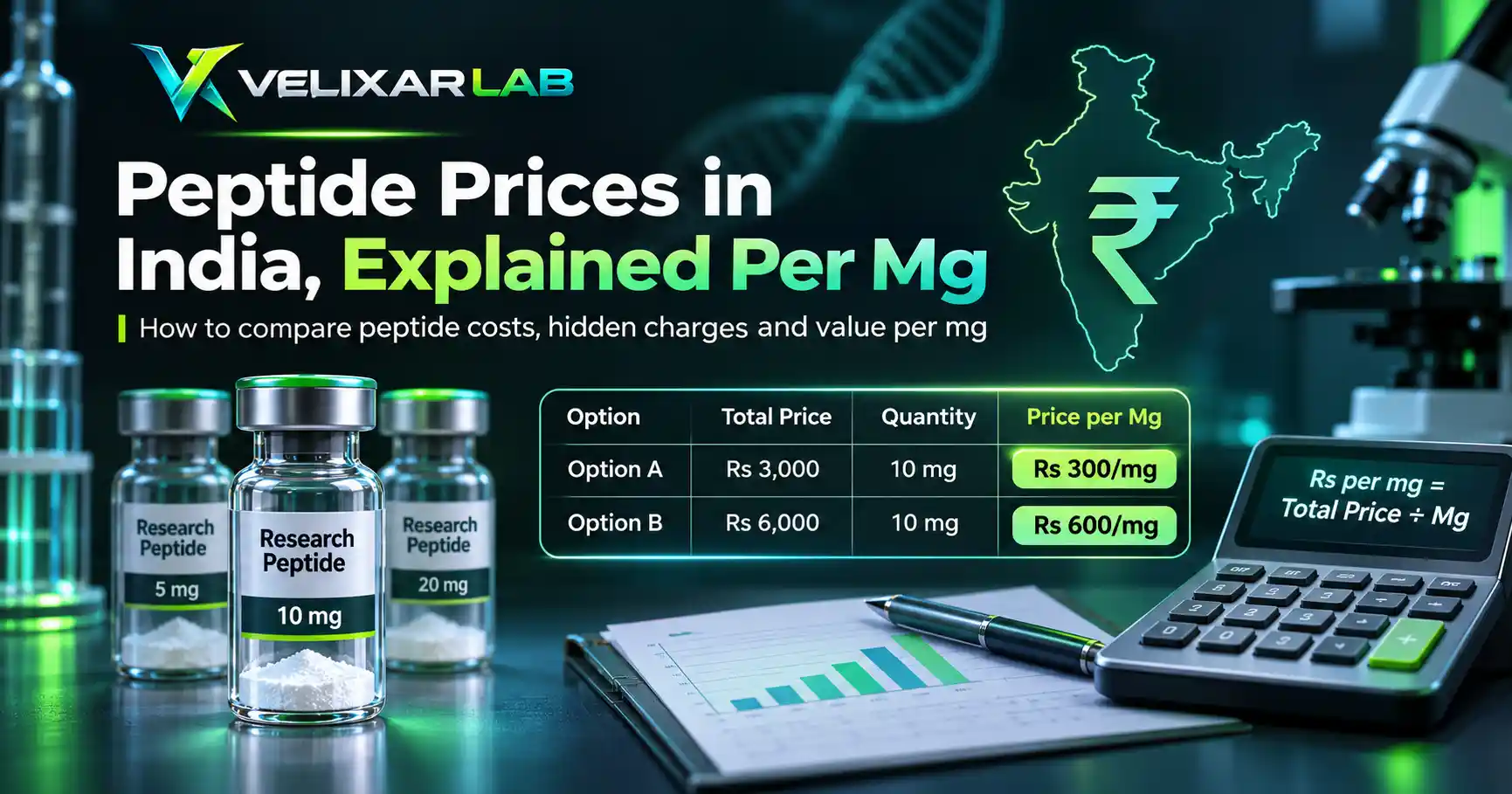
How to calculate Rs per mg
The simplest comparison divides the vial price by the milligrams listed on its label. This quick table uses the same example explained below.
| Example | Vial price | Quantity | Cost per mg |
|---|---|---|---|
| Option A | Rs 3,000 | 10 mg | Rs 300 |
| Option B | Rs 3,000 | 5 mg | Rs 600 |
These are illustrative calculations, not separate product offers.
Divide the vial price by the labelled quantity in milligrams to calculate Rs per mg. A 10 mg vial at Rs 3,000 works out to Rs 300 per mg, while a 5 mg vial at Rs 3,000 works out to Rs 600 per mg. The vial price alone cannot tell you which offer is cheaper per unit of material.
The formula is Rs per mg = listed vial price ÷ labelled mg per vial. For a multi-vial offer, check whether the stated price applies to one vial or an entire box. Calculate the total labelled quantity for the pack only after confirming how many vials it contains.
Remember that the label states a nominal quantity. A calculation based on that label does not establish actual fill, chemical identity or batch consistency. A smaller Rs per mg number is useful only when the specifications and available evidence are comparable.
For blends, read the declared composition carefully. A 10 mg combined blend is not necessarily 10 mg of each ingredient. Do not assign a unit price to each component unless the respective quantities are specified. That mistake can make two superficially similar listings look equivalent.
What actually changes a peptide’s price
Compound identity, vial size, documentation and handling arrangements are the main reasons peptide listings differ in price. Two products in the same search result can represent different quantities or specifications.
Compound and vial size: Different sequences, formulations and quantities involve different manufacturing and handling requirements. A larger vial may have a lower listed Rs per mg, but compare only like-for-like compounds and check whether the mg refers to one vial or a combination product.
Batch testing documentation: Analytical records and traceability add work for a supplier. Ask whether batch-specific details are available, what methods were used and whether the records correspond to the supplied lot. A higher price alone is not evidence that a product has been tested. For scientific context, see NIST research on peptide quantification methods and reproducibility, which examines how analytical measurement methods can differ.
Cold-chain packing and shipping: Some materials call for temperature-conscious handling or insulated packaging. Requirements vary by compound, formulation and transit conditions, so do not assume identical cold-chain needs for every order. Check the supplier’s stated shipping arrangements.
Bacteriostatic water: A separate vial may be included in the order or sold as an extra. Bacteriostatic water is commonly sold separately in India for roughly Rs 149 to Rs 449. Check what comes with an order rather than treating that amount as automatically included. Follow appropriate material documentation and approved laboratory handling protocols.
Hidden costs to check before you order
Before comparing peptide prices, confirm the exact compound, milligrams per vial, number of vials per pack, batch documentation, shipping charges, COD eligibility and the damaged-package policy. This quick buyer checklist helps catch costs that a headline price may hide.
- Confirm whether the quote is per vial or per box.
- Check the labelled mg and any stated blend composition.
- Ask which batch-related documents are available.
- Review the total price including shipping and included supplies.
- Check COD eligibility and the procedure for damaged deliveries.
The final payable amount, not just the product listing price, determines what an order costs. Read the pack description and written policies before making comparisons.
Per box versus per vial: Some marketplace quotes cover a box of ten vials rather than one vial. For example, Rs 15,000 for a ten-vial box means Rs 1,500 per vial before other costs, provided all ten vials match the stated contents. Never compare a box quote directly with a single-vial quote.
Delivery charges: Look at the checkout total. A cheaper vial can become a dearer order when courier and packing charges are added. For an order with several items, check whether shipping is charged per shipment or per product.
Cash on Delivery: COD availability is not necessarily the same at every postcode. VelixarLab’s shipping policy says COD is offered at eligible locations, subject to courier coverage. Check eligibility instead of assuming the option will appear for every destination.
Damaged orders: Read the damage-reporting and replacement terms. Find out what photographs or order details are needed and the time allowed for reporting a problem. A supplier’s response process is part of the practical cost of an order, especially for fragile laboratory materials.
Cheap price red flags
A very low price calls for closer checking, but is not proof of poor quality. The useful question is whether the seller can explain the price and support the product description.
Purity percentages without batch evidence: A stated percentage is difficult to evaluate without identifiable documentation for the relevant lot. Learn to read a peptide COA so you can distinguish what a document reports from what it does not establish. Do not treat a marketing percentage as independently verified.
Prices far below other sellers: There may be a legitimate explanation, including a different quantity or pack format. If none is provided, verify the mg, compound identity and included items before assuming it is an equivalent offer.
No physical contact details: A missing business address or meaningful contact route makes questions about orders and documentation harder to resolve. Contact details do not prove product quality, but their absence should prompt further questions.
One warning sign alone may have an innocent explanation. Compare the full specification, available records and supplier policies rather than judging on the headline number.
VelixarLab peptide price list
These are VelixarLab’s stated prices for the listed vial quantities in Indian rupees. Use them as a reference for the Rs per mg calculation and check the product page and checkout for current charges before ordering.
| Product | Quantity | Price | Rs per mg |
|---|---|---|---|
| BPC-157 | 5 mg | Rs 3,000 | Rs 600 |
| CJC-1295 (No DAC) + Ipamorelin | 10 mg combined | Rs 3,000 | Rs 300 (combined) |
| GHK-Cu | 100 mg | Rs 3,000 | Rs 30 |
| MOTS-C | 10 mg | Rs 3,300 | Rs 330 |
| NAD+ | Not stated here | Rs 3,500 | Not calculated |
| TB-500 | 5 mg | Rs 3,500 | Rs 700 |
| Retatrutide | 15 mg | Rs 4,000 | About Rs 266.67 |
Every order includes a free bacteriostatic water vial, and batch COA details are available on request.
NAD+ is a related research compound, not a peptide. Its labelled mg quantity has not been specified in this comparison, so a per mg figure would be speculative. For the CJC-1295 and Ipamorelin blend, the shown calculation uses the combined quantity, not the amount of either separate component.
Notice how a similar vial price can lead to very different unit prices. That does not mean these compounds are interchangeable. The relevant comparison for procurement remains the same compound, specified quantity, documentation and overall order cost.
Frequently asked questions
What is the average peptide price in India?
Many single research peptide vial listings fall around Rs 2,500 to Rs 5,000, but an average across all sizes and compounds is not very informative. Compare the labelled mg and final cost instead.
Why do peptide prices differ so much between sellers?
Compound, vial size, available analytical documentation, packing and delivery arrangements can all differ. First check that the two offers are describing comparable material.
Is a cheaper peptide always worse?
No. A lower price does not establish poor quality, and a higher price does not establish better quality. Check the specification and batch-related information available.
Does the price include bacteriostatic water?
It depends on the supplier. VelixarLab states that each order includes a free bacteriostatic water vial, while some other listings price it separately.
Is COD available on peptide orders in India?
VelixarLab offers Cash on Delivery for eligible locations. Eligibility depends on courier coverage and the site’s shipping policy.
How to judge the final price
Compare Rs per mg only for the same compound and a comparable specification. Check batch-related documentation alongside the labelled quantity and final payable amount. Confirm the pack size, shipping charges and damage-handling terms before ordering. That combination is a more reliable basis for evaluating price than a sticker amount by itself.
Last updated: November 2026.